Valerian T. D'Souza, Ph.D.
Dr. D'Souza received his M.Sc. from Bombay University, India, and his Ph.D from the University of Detroit. He held a postdoctoral position at Northwestern University prior to joining the UMSL faculty in 1987. He retired in 2025 and was accorded Emeritus status.
Research Interests
The main goal of our research project is to build redox catalysts based on the chemistry of biological redox enzymes. The incredible power of the enzymes to bring about chemical transformations with large acceleration and high specificity has been mainly attributed to their ability to bind the substrate and catalyze specific reactions of the bound substrate. Thus, these redox catalysts are designed to have a binding site to bind particular molecules and a catalytic site to catalyze redox enzymes. We synthesized the first generation of these artificial enzymes using cyclodextrins as a binding site and flavin derivatives as catalytic site shown in the figure.
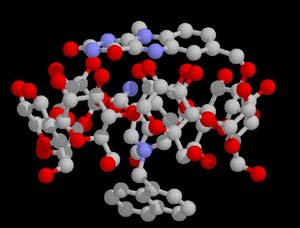
This artificial enzyme can accelerate oxidation of benzyl alcohols up to 650-fold over that catalyzed by riboflavin. We are in the process of designing and synthesizing the second generation of artificial redox enzymes which should have enhanced catalytic ability. These enzymes are designed using computational chemistry techniques.
In the process of developing the methodology to build these artificial enzymes, we have also produced a method to synthesize custom-designed cyclodextrins. Cyclodextrins are cyclic oligosaccharides which have gained prominence in the last two decades as complexing agents for various organic molecules in artificial enzymes, foods, flavors, etc. However, the main shortcoming of this, otherwise remarkable, molecule is that the functionalities available for useful chemical processes are limited to simple hydroxyl groups. The new method developed by us enables us to synthesize cyclodextrins with various desired functionalities. We are presently investigating the binding and catalytic properties of these new cyclodextrins.
Selected Publications
"Synthetic methodology for cyclodextrin-dipyrromethane conjugates," J. N. Swamy, R. E. K. Winter, C. R. Jeffreys and V. T. D'Souza, Tet. Lett., 2004, 45, 7595.
"Modification of Cyclodextrins for Use as Artificial Enzymes," V. T. D'Souza, Supromolecular Chemistry, 2003, 15, , 221.
"Selectively Mono-Modified Cyclodextrins. Synthetic Strategies," S. Tian, H. Zhu, P. Forgo and V. T. D'Souza J. Org. Chem., 2000, 65, 2624 .
"The Use of High Resolution NMR Spectroscopy in Supramolecular Systems," Peter Forgo and Valerian T. D'Souza, Organic Letters, 1999, 1, 1543.
"An NMR Approach for Determination of the Substitution Pattern in Supramolecular Systems," Peter Forgo and Valerian T. D'Souza Tetrahedron Letters, 1999, 40, 8533.
"Methods for Selective Modifications of Cyclodextrins". A. R. Khan, P. Forgo, K. J. Stine and V. T. D'Souza, Chemical Reviews, 1998, 98, 1977.