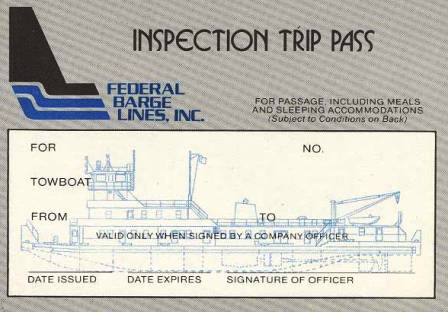
SCOPE: The contents of this collection includes primary and secondary materials pertaining to the operation of towboats and barges by Federal Barge Lines, Inc. and built by various shipbuilders from the 1950's through the 1970's. This collection deals with towboats and barges and concerns for their maintenance.
This collection contains significant archival material concerning the history of Federal Barge Lines, a company first ran by the United States government during World War I and eventually sold to Saint Louis Shipbuilding, owned by businessman Herman T. Pott.
HISTORY: After a congressional committee had surveyed the strain of World War I on the country's transportation facilities, it was suggested that inland waterways and terminals could be utilized to help relieve an acute shortage of railroad cars created by the demands of war. Provisions of the Federal Control Act of 1916 gave control of the railroads to the federal government; and the Director General of the Railroads, Mr. W.G. McAdoo, commandeered all privately owned floating equipment on the Mississippi and Warrior Rivers in 1918. New equipment was purchased and weekly service on the Mississippi River between St. Louis and New Orleans began.
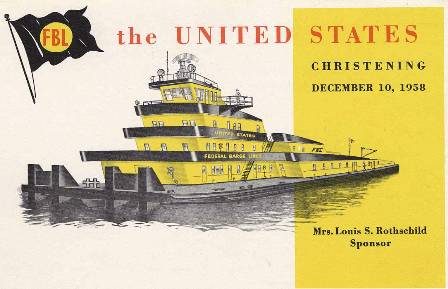
The Inland & Coastwise Waterways Service was established by the 1918 Federal Control Act to serve as a temporary boost to ailing inland waterways companies. All privately-owned equipment on the New York State Barge Canal and the Mississippi and Warrior rivers were commandeered as an emergency measure until new vessels could be built. The Inland Waterways Corporation was created in 1924 "to promote, encourage, and develop water transportation, service, and facilities in connection with the commerce of the United States, and to foster and preserve in full vigor both rail and water transportation." To fulfill the water transportation aspect, the Corporation operated barge lines called the Federal Barge Line on the Mississippi-Missouri and Warrior Rivers. As a result of a successful bid in 1953 a subsidiary of the St. Louis Shipbuilding and Steel Co. took over the Inland Waterways Corporation (Federal Barge Lines).
To read more about the history this corporation, see "The Federal Barge Line," by William J. Petersen, The Palimpsest, vol. 53 (September 1972), pp.390-401. (Copyright 1972. State Historical Society of Iowa. Used with the permission of the publisher.)
PROVENANCE: This collection was donated to the The Herman T. Pott National Inland Waterways Library in 1985 by John F. Lynch, former president of the Federal Barge Lines, after Federal Barge Lines equipment was sold to the Ohio River Company. Robert A. Labdon, former marine superintendent and vice president in charge of maintenance and repairs of Federal Barge Lines, donated his manuals and photographs.
EXTENT: 28 1/2 linear feet of blueprints, papers, and photographs. There are annual reports, advertising, clippings, public relations materials, and history of Federal Barge Lines in The Waterways Journal Collection.
ACCESS: This is collection P-002. This collection is available for on-site use only in the Rare Book and Manuscripts Reading Room. Some of the collection may be photocopied, digitally scanned or photographed, depending on condition. Researchers are advised to call ahead concerning changes in hours due to University intersessions and holidays. The St. Louis Mercantile Library is located on levels one and two of the Thomas Jefferson Library building. More information about conducting research with the archival collections of the Library, including current building hours and reading room policies, can be found on our Research page.
Preferred Citation note: The preferred citation for this collection is "From the Collections of the St. Louis Mercantile Library at the University of Missouri-St. Louis.”

INVENTORY
The Federal Barge Lines materials are arranged into seven series:
- Finances
- Traffic
- Operations
- Engineering and Maintenance
- Machinery History
- Blueprints
- Photographs
Series 1: Finances includes:
- Financial statements
- Barge charter agreement contracts and rates
- Fleeting and towing agreements
- Maintenance and damage budgets
- Insurance correspondence
- Sales information for towboats and barges
- Contract for the salvaging of a sunken barge
The papers are mostly from the 1960's and early 1970's, except for a 1928 consultant's report on the Tri Cities River Terminal at Davenport, Rock Island, and Moline and the Annual Costs and Statistics of the Inland Waterways Corporation for 1938. The papers in this series do not reflect all financial aspects of Federal Barge Lines, but they represent the financial considerations of the maintenance and repair of towboats and barges.
Series 2: Traffic includes costs for specific cargo movements and the notes and considerations used to arrive at those costs, such as:
- Size and type of barge needed;
- Navigational considerations (including weather forecast)
- Repair facilities
- Cleaning costs
- Damage costs from loading and unloading
- Towboat requirements including fuel, manpower, and insurance

Series 3: Operations includes:
- Materials about ports visited by Federal Barge Lines
- Army Corps of Engineers and Coast Guard information which affected Federal Barge Lines, such as:
- proposed projects and Lock and Dam 26 information
- employee information such as seniority lists
- engineer applications
- training programs
- Safety information
- Environmental regulations (mostly regarding water pollution)
- River stages for the Mississippi River and its major tributaries from 1972 through 1976.
- List of files relating to Federal Barge Lines' operations which were sent to the National Archives
Series 4: Engineering and Maintenance is divided into two subseries for Barges and Towboats. Contents include:
- Inventories
- Descriptions and specifications of barges owned by Federal Barge Lines
- Financial reports and budgets regarding maintenance of barges and towboats
- Inspection reports
- Conversion specifications (for converting steam towboats to diesel and barges for one kind of cargo to barges for another kind of cargo)
- Correspondence regarding maintenance
- Advertising brochures
- Catalogs
- Operation manuals from companies producing marine equipment,e ngines, and parts and maintenance products
- Rare operation manuals for Busch-Sulzer diesel engines from the 1940's
- Extensive correspondence with Cooper Bessemer regarding towboat engines and parts
- Lubrication and engine performance records for towboats
- Limited amount of blueprints specific to the maintenance problems being studied.
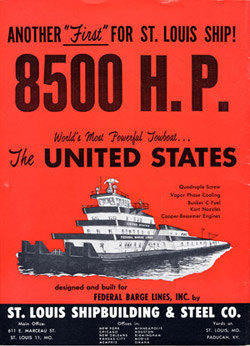
Series 5: Machinery History is a collection of files which were labeled "Machinery History" and deal with the machinery of towboats. They are arranged alphabetically by the motor vessels' names and chronologically for each motor vessel. The materials in the folders describe repairs done to the towboats and include parts requisitions and labor and parts costs. A few machinery blueprints are included when necessary. Box 23 contains files dealing with the re-powering (new engines) of specific towboats, electrical conversion from DC to AC, and renovation specifications.
Series 6: Blueprints consists of 34 boxes of blueprints of towboats and barges which belonged to Federal Barge Lines. The blueprints are divided into two subseries for Towboats and Barges.
The towboat blueprints are arranged by number. Consecutive numbers indicate a single project-one particular towboat. Different builders had different numbering systems and the Inland Waterways Corporation changed numbering systems, so numbers skip around. Therefore, groups of numbers have been given a loosely chronological arrangement. The blueprint plan numbers are found on the right hand side of the folder label and indented under the folder title in this inventory.
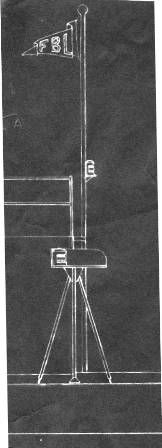
Towboat blueprints include:
- Defense Plant Corporation (D.P.C.) blueprints (mostly for steam powered, twin screw towboats)
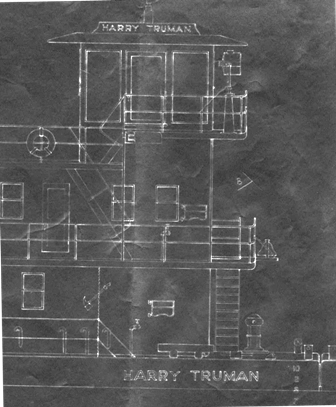
- Blueprints for the Inland Waterways Corporation (I.W.C.) integrated tow (a diesel powered twin screw towboat for a combination of box barges and bow barges) for the M/V Harry Truman
- Steamer blueprints for steam powered twin screw towboats
- Twin screw towboat blueprints, which were diesel conversions from steamers
- Plans for quadruple screw towboats with four diesel engines and for miscellaneous tugboats made by other shipbuilders
- Reconstruction of the hull of the Santa Maria, which Federal Barge Lines towed up the Mississippi River to St. Louis
Barge blueprints include:
- Covered cargo and hopper barges (used for fertilizer, cement, grain, salt, sugar, steel, pipes, tin plate, lumber, paper, and fire brick)
- Open hopper barges (used for pulp, coal and ore)
- Ocean-going barges (used for coal, raw sugar nuclear reactor parts, and oil well derricks)
- Tank barges (used for petroleum products, methanol, asphalt, phosphoric acid, soybean oil, molasses, and wine)
- Car floats (used for transporting railroad cars at Cairo, IL, built by Inland Waterways Corp. in 1931 and revised by St. Louis Ship in 1947)
- Barge parts and equipment
- Terminal and warehouse at Birmingham, AL
Blueprints within each barge group are arranged numerically by series or hull number, which is given in the folder title. The blueprints are also arranged numerically by blueprint plan number, which listed on the right side of each folder and indented under the folder title in this inventory. Blueprint numbers begin with either B are for barges or M are for hatch covers. Plans for hatch covers are filed after the barge for which they were intended.
| Barge Model | Builder | Date(s) |
|---|---|---|
| 200 Series Covered Hopper Barges | Inland Waterways Corp. | 1933 |
| 250 Series Covered Hopper Barges | Inland Waterways Corp. | 1930-1939 |
| 280 Series Covered Hopper Barges | Inland Waterways Corp. | 1938-1956 |
| Series A Cargo Barges | Inland Waterways Corp. | 1947 |
| Series B and C Cargo Barges | Inland Waterways Corp. | 1948 |
| I.W.C. Integrated Cargo Barges | American Bridge Co. | 1947-1948 |
| Series D Covered Cargo Barges | St. Louis Ship | 1948-1950 |
| Bow Barges | Alabama Dry Dock | 1951 |
| Semi-Integrated Covered Dry Cargo Barges | Dravo Corp. | 1952 |
| Semi-Integrated Covered Barges | Dravo Corp. | 1952 |
| Semi-Integrated Dry Cargo Barges | St. Louis Ship | 1954 |
| Miscellaneous Covered Cargo Barges | St. Louis Ship | 1954-1965 |
| T2000 and other 200 foot Covered Hopper Barges | St. Louis Ship | 1965-1967 |
| Semi-Integrated Open Hopper Pulp Barges | St. Louis Ship | 1967 |
| Lake and Gulf Cargo Barges | St. Louis Ship | 1957-1973 |
| Gulf Service Covered Hopper Barges | Dravo Corp. | 1953-1958 |
| Deck Cargo Barges | American Bridge Co. and St. Louis Ship | 1958-1970 |
| Large Ocean-Going Barges | G.S.I. and Zidell Explorations, Inc. | 1964-1965 |
| Oil Well Derrick Barges | Inland Waterways Corp. | 1942 |
| Double Skin Oil Barges | St. Louis Ship | 1968 |
| Oil Tank Barge #877 | St. Louis Ship | 1955 |
| Tank Barge #622 | St. Louis Ship | 1962 |
| Wine Barges | St. Louis Ship | 1956 |
| Oil Refueling Barges | St. Louis Ship | 1958 |
| Caustic Soda Barges | St. Louis Ship | n.d. |
| Car floats used for transporting railroad cars at Cairo, IL | Inland Waterways Corp. and St. Louis Ship | 1931, 1947 |
Series 7: Photos includes:
- 18 towboat photographs which hung in Robert Labdon's office at Federal Barge Lines
- 14 promotional photographs of the M/V Ernest Mack
- promotional photograph of the M/V John Alexa
- Aerial photograph of Delta Iron Works, Inc. at Houma, LA
- Two photographs of Tank Barge #877 - converted for molasses
- Other waterways photographs.
ADDITIONAL RESOURCES:
Requests for information about Federal Barge Line employees and/or medical records must be in writing with your signature and date to National Personnel Records Center for Civilian Personnel Records.
If you are writing about someone other than yourself, include as much of the following information as possible: name of agency, proof of death, full name used when employed, date of birth, social security number, dates employed, date of separation, what information you are seeking and documents.
The National Personnel Records Center is an agency of the National Archives and Records Administration. Civilian employees of the federal government are listed in the Official Register of the United States, 1816-1959, published every other year.