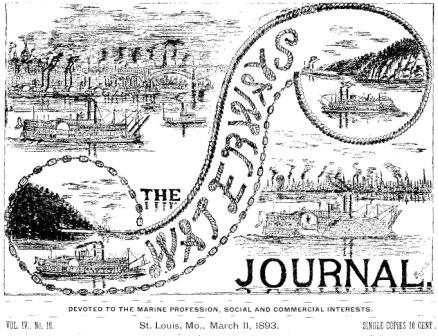
SCOPE: The Waterways Journal Collection traces the history and development of this country's rivers for transportation. The collection describes the history of steamboating and the history and present concerns of the barge and towing industry. The collection covers waterways topics such as: national water use policy, national transportation policy, competition with other forms of transportation, port development and the environmental concerns arising from river development. The collection also includes the biographies of rivermen and the pursuits of their professional associations, especially lobbying activities in favor of river development and the barge industry.
The Waterways Journal collections include editorial research files dating from the 1890s, and cover a broad array of waterway topics such as national water use and transportation policy, competition with other forms of transportation, port development, and environmental concerns. Government agencies, establishing policy and regulating waterways; and private organizations, lobbying on behalf of waterway development, influence the course of the rivers. Their interaction and influence are well documented.
Government agencies, establishing policy and regulating waterways; and private organizations, lobbying on behalf of waterway development, influence the course of our rivers. Their interaction and influence are well documented in this collection. Material from each agency or organization is located under the agency's or organization's name in Series 1, unless otherwise indicated.
Agencies and organizations involved in waterways transportation include:
Government Agencies:
- Coast Guard - in charge of aids to navigation (buoys), licensing of marine officers and personnel, inspections of marine equipment for safety and pollution control, oil spill cleanups, approving bridge clearances, establishing and enforcing Rules of the Road.
- Department of Transportation - develops national transportation policies and programs.
- Environmental Protection Agency - pollution control.
- Federal Communications Commission - electronic rules and regulations.
- Federal Emergency Management Agency - rules governing flood plains.
- Federal Maritime Commission - studies and regulates marine business in foreign commerce. Fish and Wildlife Service - wildlife conservation agency often opposed to river development projects.
- Interstate Commerce Commission - establishes tariffs and rates.
- Maritime Administration - research, development and promotion of shipping.
- Occupational Safety and Health Administration - safety rules for terminals.
- Tennessee Valley Authority - development of Tennessee River including navigation and power generation.
- S. Army Corps of Engineers - constructs and maintains channels by dredging and building locks and darns, issues permits for construction along rivers which might affect navigation or the environment.
- Water Resources Council - assesses nation's water resources and reports to Congress; established river basin commissions including: Upper Mississippi River Basin Commission, Ohio River Basin Commission, and the Souris-Red-Rainy River Basins Commission.
Private Organizations:
- Allegheny River Improvement Association - promotes waterway development on the Allegheny River.
- American Bureau of Shipping - inspects the design and construction of all types of vessels.
- American Maritime Officers Service - promotes use of American Merchant Marine. American Waterways Operators - water carrier lobbying group.
- Arkansas Basin Development Association, Inc. - promotes development of the Arkansas River and its tributaries.
- Association for the Improvement of the Mississippi River - organized to support a new Lock and Dam 26 at Alton, Illinois.
- Coosa-Alabama River Improvement Association, Inc. - promotes development of Coosa-Alabama and Mobile waterway system for navigation, power, flood control, water supply and recreation.
- Dinamo/OVIA - formerly the Ohio Valley Improvement Association, promotes development of waterways in the Ohio River Valley.
- Florida Waterways Association, Inc. - promotes development of Florida's inland waterways.
- Gulf Intracoastal Canal Association - promotes development of Gulf Intracoastal waterways in five gulf coast states.
- Inland Rivers Ports and Terminals, Inc. - promotes development of port facilities - especially for shallow draft vessels.
- Louisiana Intracoastal Seaway Association - promotes development of deep water and shallow draft waterways in south Louisiana.
- Mississippi Valley Association - promoted development of the Mississippi River and its tributaries; became the Water Resources Congress.
- National Waterways Conference, Inc. - organized to fight user charges and to keep them low.
- Ohio Valley Improvement Association - promoted development of waterways in the Ohio River Valley; now called Dinamo/OVIA.
- Propeller Club of the United States - promotes development of the American Merchant Marine.
- Tennessee-Cumberland Waterways Council - promotes development of Tennessee and Cumberland Rivers, see: Tennessee River Valley Association.
- Tennessee River Valley Association - promotes development of Tennessee River and its tributaries.
- Tennessee-Tombigbee Waterway Development Authority - organized to promote a canal to connect the Tennessee River with the Tombigbee River and continues to promote waterway development along those rivers.
- Trinity Improvement Association - promotes development of the Trinity River in Texas.
- Upper Mississippi Waterway Association - promotes canalization and development of Mississippi River for commercial transportation from Minneapolis to St. Louis.
- Warrior-Tombigbee Development Association - promotes development of Warrior and Tombigbee Rivers in Alabama.
- Water Resources Congress - formerly Mississippi Valley Association; promotes development of the Mississippi River and its tributaries.
- Water Transport Association - lobbies on behalf of tariffs and rates that are favorable to water carriers, lobbies against railroads.
HISTORY: The Waterways Journal, founded in 1887, is America's oldest continuously published inland waterways trade magazine. Current issues reflect today's barge and towing industry. It follows the history and development of river transportation and has long been known as "The Riverman's Bible." The indexing of this collection was made possible through contributions from the Waterways Journal, the J. Mack Gamble Fund, and the National Waterways Foundation.
EXTENT: 219 linear feet of papers, pamphlets, booklets, maps, photographs, newspaper clippings, government documents, environmental impact statements and scrapbooks (which were the editorial research files of the publishers, editors, and writers). Microfilm copies of The Waterways Journal periodical from 1891 to the present and bound volumes from 1924 until the present.
ACCESS: This is collection P-1. This collection is available for on-site use only in the Rare Book and Manuscripts Reading Room. Some of the collection may be photocopied, digitally scanned or photographed, depending on condition. Researchers are advised to call ahead concerning changes in hours due to University intersessions and holidays. The St. Louis Mercantile Library is located on levels one and two of the Thomas Jefferson Library building. More information about conducting research with the archival collections of the Library, including current building hours and reading room policies, can be found on our Research page.
RESTRICTIONS: None
Preferred Citation Note: The preferred citation for this collection is "From the collections of the Herman T. Pott National Inland Waterways Library at the University of Missouri - St. Louis.”
INVENTORY
Contact the curator for a complete collection inventory and index to The Waterways Journal, a portion of which is digitized and available through the Digital Library.
The Waterways Journal research collection materials are arranged into 16 series:
1. General
The first series consists of 125 linear feet - boxes 1 through 251. It is an encyclopedia of waterways topics arranged alphabetically by subject, river, state, company name, government organization name or waterways association name. Folder information contains inclusive dates for materials within the folder.This series includes environmental impact statements for many river projects, filed under the name of the river. Otherenvironmental concerns are reflected under topics such as floodplains, wetlands and water resources.
2. Biographies
The second series consists of 4 1/2 linear feet - boxes 252 through 260. It includes biographical material on men and women connected in some way to the river. All names are arranged alphabetically.
3. Boat Information
Series 3 contains 5 1/2 linear feet - boxes 261 through box 271. Information about each boat is arranged alphabetically according to the first name or initial of the boat. Folder lists indicate whether about is powered by a stearn engine: Str. (steamer), or a diesel engine: M/V (motor vessel) .
4. River Columns
Series 4 contains two linear feet - boxes 272 through 275. Newspaper columns from local newspapers of river towns have been clipped and pasted onto large cards. Each card contains the articles of one columnist arranged chronologically. Cards are numbered from 1A to however many cards there are for that columnist. "A" indicates the front, and "B" indicates the back. The columns are either about river history or current river happenings in the area .
5. Lock and Dam 26
Series 5 contains seven linear feet - boxes 276 through 289. The material in this series pertains to the controversy which arose in 1975 over whether the U. S. Army Corps of Engineers should repair, replace, or build a second lock at Lock and Dam 26 at Alton, Illinois, on the Mississippi River. That controversy continued until 1984 when Congress appropriated money to repair the original lock and build a second one. The material in this series is divided into two subseries. Subseries 1 - Papers - consists of correspondence lobbying in behalf of major improvements at Lock and Dam 26, lawsuit testimonies from 1974 through 1981, newspaper clippings and news releases from 1971 through 1985 regarding the controversy, and public relations materials published by various waterways organizations. Subseries 2 - Reports and Environmental Statements - contains many large studies and reports on engineering aspects, environmental aspects and traffic demands at Lock and Dam 26, put together by the U. S. Army Corps of Engineers another government agencies and private engineering firms.
6. Periodicals
Series 6 contains four linear feet - boxes 290 through 297 - of waterways magazines and a newspaper. These are periodicals to which the library does not subscribe. Magazines and newsletters to which the Library subscribes are located in the Pott Library reading room. Many newsletters and other publications are primarily important because of their association with, and reflection of, their parent institution, agency or company, and those are filed under the name of that institution, agency or company in one of the other series. Calliope is a newspaper published by the steamer Delta Queen. There are two different periodicals named Compass, one published byte Marine Office of America and one published by Mobil Oil Company.
7. Ports and Terminals
Series 7 contains 25 linear feet - boxes 298 through 347 - of materials relating to waterways ports and terminals and their development. Folder titles within this series are an encyclopedic collection of specific ports, terminals, cities, rivers, companies, associations, government agencies and other subjects relating to ports and terminals. They are arranged alphabetically. Series 7 includes brochures, booklets, annual reports, newspaper clippings, correspondence, newsletters, maps and government documents pertaining to over one hundred American ports and terminals - their design, construction, equipment and economics including financing and rates. This series includes materials on shallow draft and deep water ports and on liquid cargo facilities, such as deep water off shore oil terminals. It also contains information on imports, exports and foreign ports and on government rules and regulations and permits. The series has materials from the American Association of Port Authorities,an organization concerned with deep draft ports; Inland Rivers Ports and Terminals, Inc., an organization which promotes port facilities; the Maritime Administration, an agency of the U. S. Department of Transportation involved with port studies, design and development; and the Occupational Safety and Health Administration (OSHA) which is concerned with safety rules for terminals and pollution control.Information about those last two government agencies is also available in Series 1 - General. Tonnage statistics may be found in annual reports and newsletters of specific ports in this series. The Library also has regular subscriptions to some port publications and those are located with the waterways periodicals in the Pott Library. Other tonnage information may be found in the Waterborne Commerce reports published by the Army Corps of Engineers and shelved in the Pott Library.
8. Railroads
Series 8 contains three linear feet - boxes 348 through 353. The Railroad Series has small amounts of materials on history, the Penn Central, Conrail and other aspects of railroading; but the main emphasis of these papers is the fierce competition that exists between the railroad industry and the barge industry. There is substantial information about land grants to railroads and other federal aid to railroads. Information about rates, specific commodities rates,railroad rate policies and ICC proceedings are included, as reregulation and deregulation. And there are newspaper clippings and public relations brochures and speeches about railroads vs. other modes of transportation. A large amount of materials reflect the barge industry's opposition to railroad ownership of water carriers - specifically the Illinois Central Railroad's proposed acquisition of the John I. Hay Barge Company, which fell through in 1960, and the acquisition of the American Commercial Barge Line by CSX Corporation in 1984. There is also extensive information about the CSX acquisition of the American Commercial Barge Line in the John A. Creedy Collection in the Herman T. Pott National Inland Waterways Library.
9. Scrapbooks
Series 9 consists of twenty scrapbooks. Fourteen of the scrapbooks contain the "River News and River Stories" column by Joe Curtis, which appeared in the Memphis Commercial Appeal from 1936 through 1958. Joe Curtis' last scrapbook also contains his obituary. This series also contains a scrapbook which belonged to Captain Abbott Veach, the first editor of The Waterways Journal, and scrapbook of articles about The Waterways Journal collected by William Arste, the second editor. There are four other old scrapbooks in this series - one containing newspaper clippings about St. Louis, in the1880s and three containing articles about the Steamer Robert E. Lee and its race with the Steamer Natchez. The scrapbooks are in large flat boxes at the end of the collection.
10. St. Louis
There are 8 1/2 linear feet of materials about St. Louis - boxes 354 through 370. The St. Louis Series is divided into three subseries. Subseries 1 - General - includes material about the city - history; census information; transportation, cultural and business information; and materials from the St. Louis Regional Commerce and Growth Association. Subseries 2 - East West Gateway Coordinating Council -contains notes and minutes from the East West Gateway Transportation Task Force, publications from the Environmental Task Force, the Metropolitan Development Guide, minutes of the Port Development Task Force, and the Study of the Port of Metropolitan St. Louis. Subseries 3 - River, Ports - is material about the Mississippi River at St. Louis and its ports. This subseries contains river history, information about the riverfront and materials about port development. It includes materials from the Port Development Task Force and the Transportation Task Force of the St. Louis Regional Commerce and Growth Association. The River, Ports Subseries contains the large St. Louis Harbor Study, completed in 1982, and information on flood control projects by the U. S. Army Corps of Engineers. This subseries also contains extensive materials including all meeting minutes (from the beginning in 1977 through 1987) for the Port of Metropolitan St. Louis Advisory Council. The ports within the Port of Metropolitan St. Louis Advisory Council include: the City of St. Louis Port Authority, the Kaskaskia Regional Port District, the Jefferson County Port District, the St. Louis County Port Authority, the Southwest Regional Port District and the Tri City Regional Port District. This subseries also contains material on each individual port within the Port of Metropolitan St. Louis Advisory Council.
11. U.S. Army Corps of Engineers
The U. S. Army Corps of Engineers is responsible for construction and maintenance of channels in navigable waterways, dredging, locks and dams and issuing permits for construction of anything along the waterways (except bridges and overhead pipelines which are regulated byte Coast Guard). Series 11 contains 6 1/2 linear feet - boxes 371 through 383 - of materials from the U. S. Army Corps of Engineers. It is divided into five subseries. Subseries 1 - General - contains information about history, appropriations, dredge and fill regulations, navigation conferences, public notices for permits, the Repair, Evaluation, Maintenance and Rehabilitation Program, traffic and tonnage and the reorganization of the St. Louis office. Subseries 2 - Districts - contains information from each of the Corps' midwestern districts. Subseries 3 - National Waterways Study - contains some of the publications, maps and working papers from this study from 1974 to 1981. Subseries 4 - Navigation Notices -contains the public notices about special navigation hazard sin nine of the midwestern districts for 1981. Subseries 5 - News Clips - is a large amount of xeroxed copies of newspaper articles from allover the country about U. S. Army Corps of Engineers projects from1974 to the present. The news clips put out by the Corps also reflect opposition to the Corps' projects from environmentalists.
12. Upper Mississippi River Basin Commission
The Upper Mississippi River Basin Commission was established by presidential Order in 1971, to act as a regional water planning and coordinating institution to develop a consensus among member states and federal agencies on water resource policies in the Basin. The Upper Mississippi River Basin Commission is responsible for the area that drains into the Mississippi River from its beginning at Lake Itaska in Minnesota to the mouth of the Ohio River at Cairo, Illinois.The Souris-Red-Rainy Drainage Area was added to the Upper Mississippi River Basin Commission in 1973. Series 12 contains 8 1/2 linear feet - boxes 384 through 400 - of annual reports, quarterly meeting reports, correspondence, newsletters and the published reports and working papers of several major studies conducted by the Upper Mississippi River Basin Commission. Those major studies include the Comprehensive Basin Study (1965 -1972), the GREAT River Study conducted by the Great River Environmental Action Team(GREAT) from 1975 to 1982, the Main Stem Level B Study (1975-1980), the Master Plan (1978-1982) and the National Water Assessment (1975-1983).
13. User Charges
In 1978 Congress passed the Inland Waterways Revenue Act, imposing an excise tax on the use of liquid fuel for commercial waterways transportation. This tax is intended to defray the cost of maintaining the country's navigable waterways. That work is done byte U. S. Army Corps of Engineers and was previously done at government expense. There has been much controversy over the issue of user charges before and since the passage of the legislation. Series 13 contains five linear feet - boxes 401 through 410 - of materials related to the user charges controversy. It includes clippings and news releases, economic studies, speeches, reports by the U. S. Army Corps of Engineers , and publications by various organizations for or against (mostly against) user charges. The National Waterways Conference, Inc. was organized in 1962 to fight user fees and to keep them as low as possible. All of the publications, correspondence and annual meeting minutes of this group ware found in this series.
14. U.S. Government documents
Series 14 contains 3 1/2 linear feet - boxes 411 through 417 - of House and Senate bills, legislative calendars and pages from The Congressional Record and The Federal Register. The materials are from the 90th Congress (1967-1968) through the present and cover such topics as the Coast Guard, the Merchant Marines, the ICC, the Occupational Safety and Health Administration (OSHA), Rules of the Road, safety, pollution, water resources, water projects, public works, the environment, user charges, longshoremen, transportation, railroads, energy and commerce, and government operations. The materials a rearranged chronologically and the folder numbers indicate either the Congress or the Federal Register year.
15. Photographs
The Photo Series , in boxes 418 through 420, contains photographs which have been removed from the General Series, the Boat Information Series and the Ports and Terminals Series. The folder titles are the same as the titles of the folders from which the photos were removed and are arranged alphabetically. The folders in the other series indicate if photos have been removed to the Photo Series.
16. Oversize Materials
Series 16 contains eleven large flat boxes - 428 through 438 - of newspapers which relate to inland waterways. These newspapers include The American Marine Engineer, Ohio Valley Pilot, The Journal of Commerce, Log (published by the Seafarer's International Union), SIU Inland Boatman (published by the Seafarer's International Union of North America), NMU Pilot (published by the National Maritime Union) and many waterways issues of local papers published in cities located on rivers.
RELATED COLLECTIONS:
P-26: Donald T. Wright Collection