Seyed Hamid Reza Sanei, Ph.D.
Dr. Sanei’s research bridges advanced composite materials, computational modeling, and orthopedic biomechanics to improve the performance, reliability, and safety of engineered and biomedical systems. His work integrates multiscale simulation, microstructural analysis, and state‑of‑the‑art manufacturing technologies to understand how materials behave - from the microscopic level of fibers and tissues to full structural and anatomical systems.
In the field of composite materials, Dr. Sanei develops next‑generation modeling frameworks that move beyond traditional idealized assumptions. By incorporating real microstructural variability into high‑fidelity simulations, his work enables more accurate prediction of mechanical behavior and more reliable design of composites for aerospace and high‑performance engineering.
In parallel, his research in orthopedic biomechanics focuses on patient‑specific solutions for improved surgical outcomes. This includes custom 3D‑printed implants, advanced finite element modeling of orthopedic devices, and emerging work in 3D bioprinting to support regenerative medicine.
Together, these research thrusts work toward a common goal: bridging detailed material behavior with real‑world performance to enable safer structures, better medical devices, and more personalized healthcare.
Composite Modeling and Simulation
I develop multiscale, uncertainty-aware modeling frameworks that connect composite microstructure to structural performance. By integrating synthetic microstructures, image-based finite element analysis, and stochastic simulation, my work predicts both average properties and variability enabling more reliable composite design for aerospace, advanced manufacturing, and high-performance engineering applications.
My research focuses on developing physically grounded, multiscale modeling frameworks to predict both the average behavior and variability of fiber-reinforced composite materials.
Traditional micromechanics models rely on idealized fiber packing configurations (e.g., square or hexagonal arrays). While effective for estimating mean properties, these approaches cannot capture property scatter because they assume perfectly uniform microstructures.
To address this limitation, I quantify real microstructural variability through image analysis of composite micrographs and detailed characterization of constituent materials. This includes both morphological features (fiber spacing, packing statistics, local volume fraction) and constituent property variability.
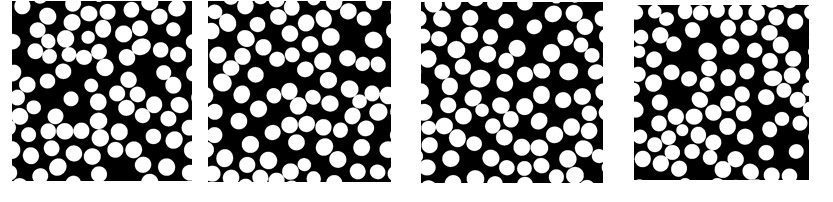
Using these statistics, I generate computer-simulated (synthetic) microstructures that are statistically equivalent to real materials but stochastically distinct (Figure 1). These synthetic microstructures provide two key advantages:
- An effectively unlimited number of realizations can be generated for stochastic analysis
- Individual microstructural features can be systematically varied to study their influence on mechanical response
The generated microstructures are periodic to facilitate displacement periodicity in finite element analysis (FEA) and are rearranged to match both short-range (nearest-neighbor spacing) and intermediate-range (radial distribution) statistics of actual composites.
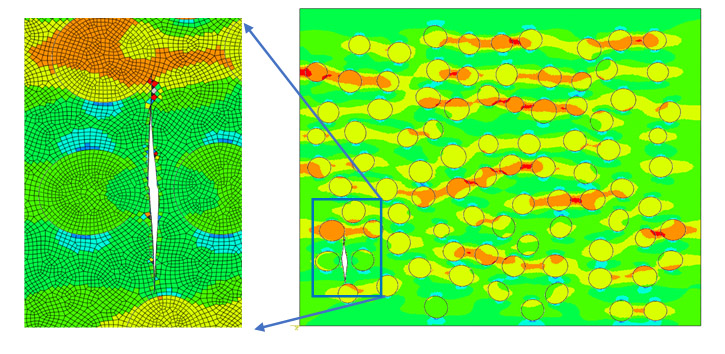
Mechanical properties are determined by directly converting these synthetic microstructures into high-fidelity, image-based finite element models (Figure 2). Extended finite element methods (XFEM) are employed to capture progressive damage and ultimate failure, including matrix cracking under transverse loading. By analyzing multiple statistically equivalent microstructure realizations, I quantify the resulting scatter in mechanical properties. These simulations demonstrate that explicitly accounting for microstructural features produces variability consistent with experimental observations, confirming the critical role of material uncertainty in composite response.
Microstructural analysis alone, however, is insufficient for predicting macroscopic behavior unless it is embedded within a multiscale framework. A central challenge in multiscale modeling is selecting the appropriate intermediate (mesoscale) length scale at which synthetic microstructures are generated.
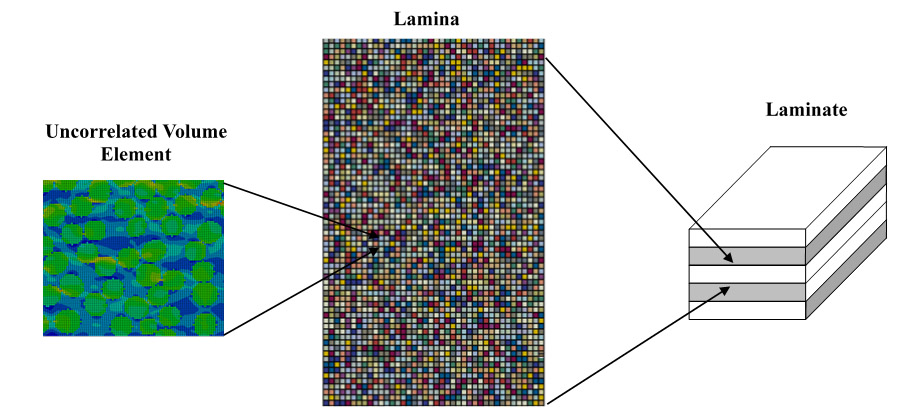
To address this, I introduced the concept of an Uncorrelated Volume Element (UVE). The UVE represents the minimum length scale at which local fiber volume fractions between adjacent regions become statistically uncorrelated. Unlike traditional Representative Volume Elements (RVEs), which focus on average behavior, the UVE preserves variability between realizations, enabling rigorous stochastic analysis.
Using UVEs as the mesoscale, statistically equivalent synthetic microstructures are generated and linked to macroscopic simulations (Figure 3). This framework enables composite behavior to be modeled seamlessly across scales, from microstructure to structural response, with local material properties varying spatially.
By running ensembles of microstructure realizations within this multiscale framework, I predict the stochastic response of composite materials, capturing full property distributions rather than single deterministic values. Including microstructural uncertainty in the finite element models enables reproduction of experimentally observed scatter and provides a powerful tool for reliability assessment and materials design.
Building on this foundation, I am continuing work in stochastic multiscale modeling while also initiating new research directions in advanced composites, manufacturing-informed modeling, and uncertainty-aware material design.
Biomechanics of Human Orthopedics
This research will revolutionize orthopedic care by harnessing additive manufacturing to create bespoke implants tailored to individual patient anatomy. The focus will be on developing a range of 3D-printed implants, such as knee, hip, and spinal devices, which not only fit perfectly with the patient's unique bone structure but also mimic the mechanical properties of natural bone. Innovations in this domain will include the integration of porous structures for enhanced osteointegration and the use of cutting-edge materials like biocompatible titanium alloys and advanced polymers. Additionally, real-time data from 3D imaging technologies like MRI and CT scans will be utilized to refine implant designs, ensuring a seamless integration with the patient's body and reducing the risk of implant rejection.
Advanced Simulation Techniques for Orthopedic Biomechanics:
This area of research will focus on advancing the simulation models for orthopedic implants and fixation devices, aiming to predict their biomechanical performance under various physiological conditions accurately. By leveraging sophisticated computational tools like finite element analysis (FEA), the research will simulate the behavior of implants in response to dynamic loads and stress patterns experienced during daily activities. The goal is to enhance the design of orthopedic devices for optimal performance, longevity, and patient comfort. This approach will also explore the simulation of complex surgical procedures, providing surgeons with invaluable insights into the mechanical implications of their operative strategies and decisions.
Biomechanical Analysis of Orthopedic Surgical Techniques:
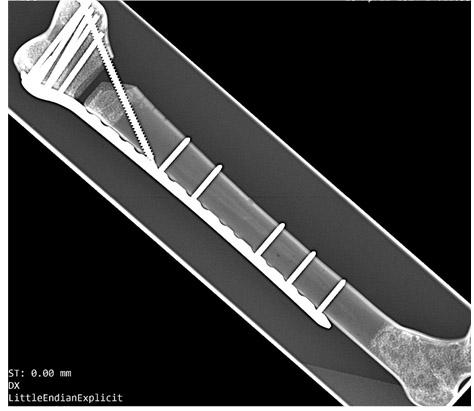
This research direction will provide groundbreaking insights into the biomechanical aspects of various orthopedic surgical techniques. By conducting detailed biomechanical analyses of different surgical approaches and fixation methods, the research aims to optimize these procedures for improved patient outcomes. In one of our current research efforts, we evaluated the biomechanical stability of cannulated medial column screws combined with a lateral locking plate (LLP) in distal femur fractures in osteoporotic bone, this method was used as an adjunct fixation technique with a Lateral Locking Plate (LLP). The stability of this minimally invasive construct is compared to conventional Dual Plate Fixation in terms of biomechanical properties. An Xray image of the construct is shown in Figure 4.
3D Bioprinting of Orthopedic Tissues and Structures:
At the cutting edge of regenerative medicine, this research will explore the potential of 3D bioprinting for creating orthopedic tissues such as bone, cartilage, and ligaments. The focus will be on developing bioprinting techniques that can produce viable, functional tissues for use in reconstructive surgeries and injury repair. This will involve pioneering work in the selection and development of bio-inks, scaffolding materials, and cell types that can be used to print structures mimicking the complex architecture of native tissues. The research will also tackle the challenges of vascularization and integration of bio printed tissues with the patient's existing biological structures, potentially revolutionizing the field of orthopedic surgery and rehabilitation.