PRIMED℠
For more than two decades, one central part of the mission of the Center for Character and Citizenship at the University of Missouri–St. Louis has been a simple but powerful question: What actually works in character education?
To answer this question, CCC scholars have led extensive research efforts focused on collecting, analyzing, and translating evidence from the character education literature. This work—known as What Works in Character Education—examined dozens of studies to identify practices that consistently support students’ moral, social, and civic development.
Over time, this research led to the creation of PRIMED℠: a set of six research-based design principles that guide effective character education in schools.
Rather than offering a long list of disconnected strategies, PRIMED provides educators with a clear framework—one that helps schools design character education that is intentional, flexible, and grounded in evidence.
What Is PRIMED℠?
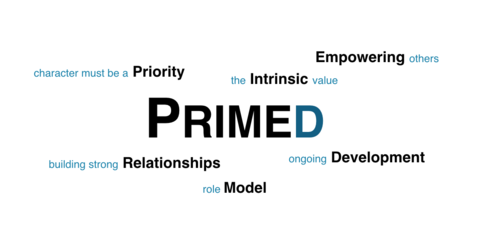
PRIMED℠ is an acronym for six core design principles that organize and unify more than 40 evidence-based character education strategies identified through CCC’s research.
The goal of PRIMED is twofold:
- To make research on character education clear and usable for educators and school leaders
- To offer guiding principles, not scripts—allowing schools to adapt character education to their unique contexts
The six PRIMED principles work together. They are not isolated ideas. Instead, they overlap, reinforce one another, and shape the culture of a school as a whole.
The Six Design Principles
P – Prioritization
For character education to be effective, it must be a true priority, not an add-on.
This means character development is clearly reflected in a school’s mission, daily language, decision-making, and leadership practices. It shows up in how adults talk with students, how discipline is handled, and how success is defined.
School leaders—especially principals—play a key role here. When leaders consistently model that character matters, the entire school culture begins to align around that priority.
R – Relationships
Strong schools are built on strong relationships.
Research consistently shows that the quality of relationships—between teachers and students, among staff, and across the school community—is essential not only for character development, but also for academic success.
Effective character education requires schools to be intentional and strategic about building trust, care, and mutual respect among all members of the school community.
I – Intrinsic Motivation
The goal of character education is not just for students to know about values, but to internalize them.
When character becomes part of who students are—not something they perform for rewards or recognition—they are motivated from within to act with integrity, kindness, and responsibility.
PRIMED emphasizes approaches that move away from heavy reliance on external rewards and toward:
- Positive role modeling
- Meaningful relationships with adults
- Private affirmation rather than public comparison
- Opportunities for students to reflect on and guide their own character growth
M – Modeling
Students are always watching.
Decades of research show that young people learn far more from what adults do than from what they say. Every interaction—how conflict is handled, how mistakes are owned, how respect is shown—teaches powerful lessons about character.
Modeling is not just an individual responsibility. It is part of a school’s adult culture, and school leaders play a critical role in helping adults reflect on and strengthen the messages they send through their behavior.
E – Empowerment
Character grows when people have a voice.
Empowerment means creating schools where students, teachers, and staff are respected as contributors—not just rule followers. It involves sharing power, inviting participation, listening deeply, and taking others’ ideas seriously.
Empowering schools:
- Create space for student leadership
- Encourage shared decision-making
- Support collaboration rather than control
- Help students practice the skills of democratic life
Empowerment supports both character development and long-term school success.
D – Developmental Pedagogy
Schools shape who students become, not just what they learn.
Developmental pedagogy emphasizes teaching methods and discipline practices that support students’ long-term growth—academically, socially, emotionally, and morally.
Rather than relying on overly rigid, punitive, or performance-driven approaches, PRIMED encourages:
- Cooperative learning
- Restorative practices
- Teaching methods that honor how children grow and change over time
Research shows that when schools support whole-child development, positive effects on both character and academic outcomes can last for years.
Why PRIMED℠ Matters
PRIMED℠ offers schools a clear, research-based roadmap for building strong character cultures—without prescribing one-size-fits-all solutions.
By focusing on priorities, relationships, motivation, modeling, empowerment, and development, PRIMED helps educators design environments where character is formed naturally through everyday practice.
PRIMED is not a program to adopt. It is a way of thinking, a way of leading, and a way of building schools where people flourish.
The Book
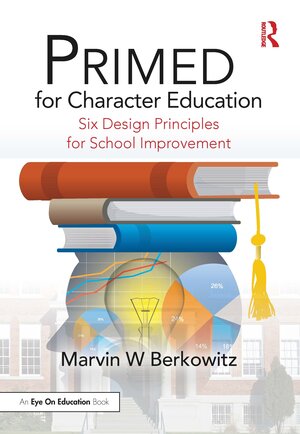
Dr. Berkowitz’ book, PRIMED℠ for Character Education: Six Design Principles for School Improvement, is available for purchase.
PRIMED℠ was selected by Greater Good Magazine as one of its favorite books for educators in 2021.
 PRIMED℠ for Character Education is now published in a Spanish language edition.
Spanish edition and purchase information.
Also available on Amazon.
 PRIMED℠ for Character Education is now published in a Chinese language edition.
PRIMED to Compete: Coaching for Character
 Written by Dr. David L. Shields, Dr. Marvin Berkowitz, and Dr. Pete Paciorek, PRIMED to Compete: Coaching for Character shows how sports can be a powerful setting for character development—when coaches are intentional.
Bringing together cutting-edge science and real-world coaching experience, PRIMED to Compete helps coaches turn the challenges of competition into meaningful opportunities for growth, resilience, and ethical development.
The book is now available!
The Videos
Watch all six animated videos created by CoSchool in Bogota, Columbia in which Marvin Berkowitz explains each of the six characteristics of the PRIMED℠ model.
Watch the April 2021 video produced by Character.org, in which Marvin Berkowitz gives an overview of the PRIMED℠ model and his book, PRIMED℠ for Character Education: Six Design Principles for School Improvement.