

Cultivating Virtue for Leadership (CViL)
Cultivating Virtue for Leadership (CViL) is a virtue-based model of servant leadership developed by the Center for Character and Citizenship (CCC). CViL supports school leaders in cultivating the personal and organizational virtues needed to lead with integrity, care, and purpose—creating school cultures where educators and students can flourish.
Grounded in research on effective school leadership and evidence-based character education, CViL positions leadership not as command and control, but as service, stewardship, and moral responsibility.
What Is Servant Leadership?
Servant leadership is a leadership philosophy first conceptualized by Robert K. Greenleaf, which emphasizes relationships, moral authority, and persuasion rather than hierarchy or power. In this approach, leaders see themselves as stewards—responsible for nurturing people, building trust, and responding thoughtfully to the needs of their communities.
Servant leaders:
- listen with humility
- value and empower people
- practice empathy and forgiveness
- promote trust and equity
- build community
- act for the common good
- share power and responsibility
In schools, servant leadership recognizes that everyone—principals, teachers, coaches, and staff—can model leadership through character.
The CViL Framework
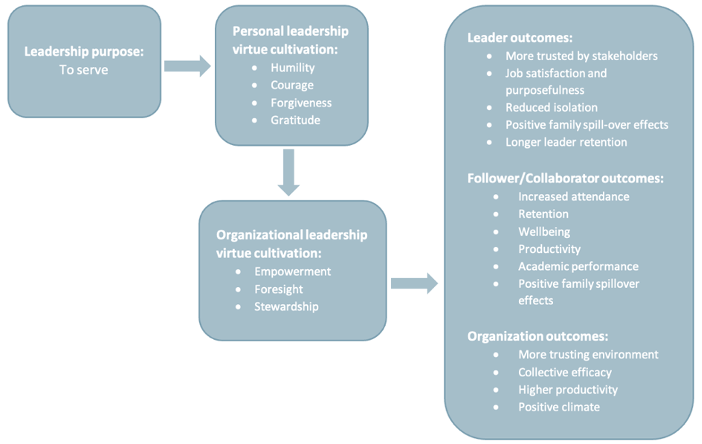
The CViL model builds on a virtue-based theory of servant leadership (van Dierendonck & Patterson, 2015). It proposes that leadership begins with a noble purpose to serve, which motivates the cultivation of key personal virtues. These personal virtues, in turn, animate organizational leadership practices that shape school culture and climate.
Personal Leadership Virtues:
- Purpose – Commitment to goals that benefit others and contribute to the common good
- Humility – Recognizing one’s limitations and valuing others’ contributions
- Courage – Willingness to take risks and try new approaches
- Gratitude – Appreciating and acknowledging the good in others
- Forgiveness – Letting go of resentment and restoring relationships
- Integrity – Acting consistently with strong moral principles
Organizational Leadership Virtues:
- Equity – Promoting fairness and justice while recognizing different needs
- Empowerment – Enabling others to make decisions and take action
- Foresight – Learning from the past, understanding the present, and anticipating future consequences
- Stewardship – Caring responsibly for people, resources, and institutional trust
These virtues function as an integrated whole. As one mentor described, they are “like the atoms in a water molecule—remove one, and you no longer have water.”
Why CViL Matters for Schools
Research shows that school principals have a powerful influence on student achievement and well-being through their impact on teachers and school climate. CViL supports leaders in cultivating the virtues that sustain this influence over time.
CViL Model:
Research-Based and Internationally Tested
The CViL model has been developed and tested through professional development with school leaders and instructional coaches in the United States, Kenya, and Mexico, with support from the John Templeton Foundation, Templeton World Charity Foundation, and the Kern Family Foundation.
Research shows that servant leadership virtues can be intentionally cultivated through sustained professional learning and mentoring, positioning leaders to support healthy school cultures over time.
CViL Virtues in Practice
View videos of educational leaders describing how they incorporate the 8 character virtues into their work.
Noble Purpose
Humility
Graditude