ORA HOME | NEWSLETTER ARCHIVES | CONTACT US | PDF
![]() |
OFFICE OF RESEARCH ADMINISTRATION NEWSLETTER | December 2006 |
![]() |
What's Inside RESOURCES
|
RESEARCH & COMMERCIALIZATION NEWS UNIVERSITY OF MISSOURI NEWS
OTHER NEWS OF INTEREST
UM-St. Louis Science Faculty Among Most Frequently Read Both Jingyue "Jimmy" Liu, Professor and Director of the Center for Molecular Electronics, and George W. Gokel, Distinguished Professor and Associate Director of the CME, recently have been recognized as authoring a most-frequently read or cited article in top academic journals. Liu's "Scanning Transmission Electron Microscopy and its Application to the Study of Nanoparticles and Nanoparticle Systems," (Journal of Electron Microscopy, Jun 01, 2006; 55: 183-189) was the second most frequently read article in the Journal of Electron Microscopy during October 2006. Gokel was honored with the Bioorganic & Medicinal Chemistry Most Cited Paper 2003—2006 Award for "Functional, Synthetic Organic Chemical Models of Cellular Ion Channels." (Bioorganic & Medicinal Chemistry, Mar 15, 2004, Vol. 12, Issue 6, pages 1291-1304). l
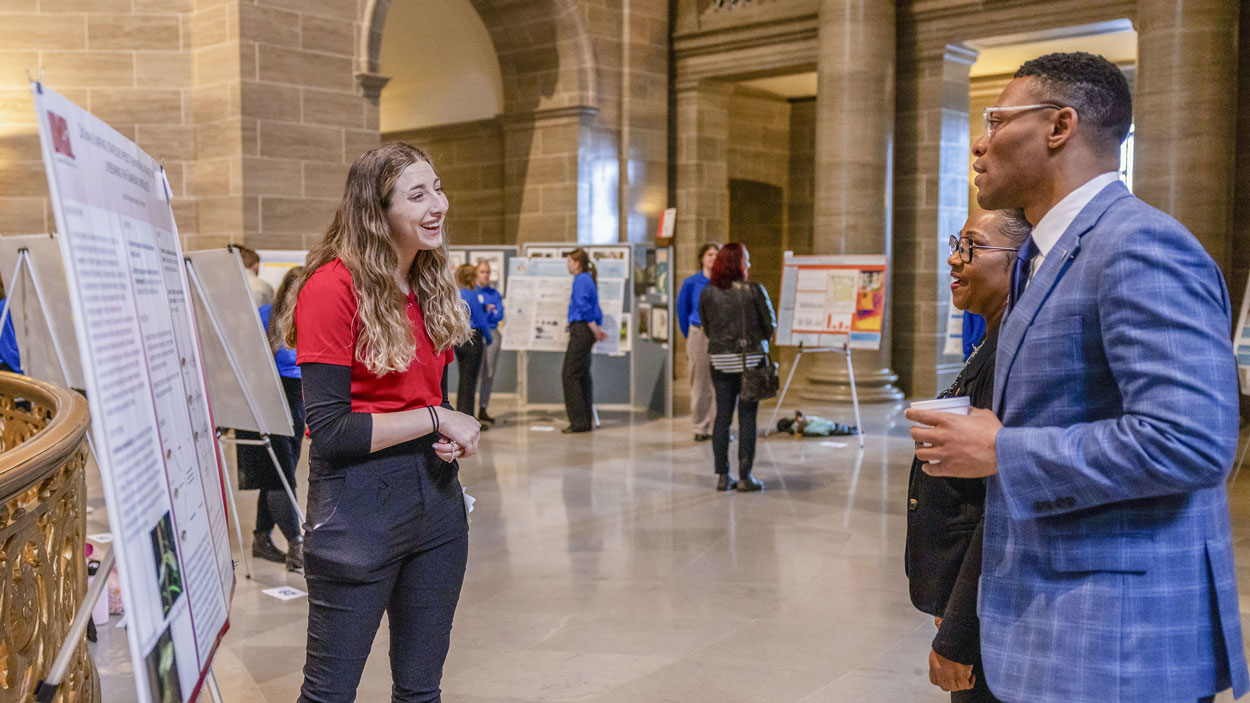
Undergraduate Research Finds New Support at UM-St. Louis Undergraduate research is increasingly seen as an important part of learning that not only can help prepare students for a more successful graduate research experience but also better prepare them for careers in almost any field. In January 2006, as part of an effort to provide more substantial undergraduate research support, UM-St. Louis hired Dr. Kathryn Walterscheid as Director of Undergraduate Research in the College of Arts and Sciences. Since then, a new web page for undergraduate research at the University has been developed and launched. The site, which went online last month, provides information about undergraduate research programs, such as the Undergraduate Research Symposium, where students present their research in poster and oral formats as they would at a professional conference, and the Undergraduate Research Day at the Capitol, in which students display their research posters to legislators and visitors in the Capitol rotunda in Jefferson City. For more information on undergraduate research at the University of Missouri-St. Louis, visit http://www.umsl.edu/divisions/artscience/uresearch/index.html. l
NIH R01 Grant Applications Go Electronic: Training to be Held December 5 November 28, 2006 Beginning with the Feb. 5, 2007, standard receipt date, the National Institutes of Health (NIH) will require all Research Project Grant R01 applications be submitted electronically -- no paper applications will be accepted. This change marks a major milestone in the NIH's transition to receive all grant applications electronically, which began with the electronic submission of Small Business Innovation Research (SBIR) applications in December 2005. "NIH has been committed to using information technology to improve the grants administration process for many years," said Dr. Norka Ruiz Bravo, NIH Deputy Director for Extramural Research. "We look forward to applicants benefiting from a single federal interface for finding opportunities and submitting applications online; reviewers having access to crisp, clear, color applications; and staff processing of applications with a consistency that can be achieved only through electronic processes." The transition to electronic submission requires that two systems with their own registration and validation processes work together: Grants.gov, the federal government's single on-line portal to find and apply for federal funding, and eRA Commons, the system that allows applicants to interact electronically with NIH. The transition also involves the simultaneous shift from the long-used PHS 398 application form to a new trans-agency standard form, and fundamentally changes the process by which investigators and grant applicant institutions manage their grant submissions. NIH expects that the R01 transition will set new application submission records both at Grants.gov and within the NIH eRA Commons. NIH recently made performance and capacity improvements in its systems and helpdesks and is positioned to handle the expected increased load. In addition, NIH has developed contingency plans to ensure that any issues that do arise can be addressed quickly and that applicants are not penalized for system problems. To assist applicants and organizations through this transition, the NIH will host a training event on Tuesday, December 5. The training is available in-person and via Web cast and will be archived for later viewing http://era.nih.gov/training/esub_120506/. Information on the submission process and additional training and promotional resources are available on the NIH Electronic Submission of Grant Application Web site: http://era.nih.gov/ElectronicReceipt/. To ensure a smooth transition, NIH is strongly encouraging all potential principal investigators to contact their central grants offices immediately to learn how their institutions are handling these application form and process changes. Electronic Submission to the NIH for UMSL Faculty/Staff: The University of Missouri-St. Louis is registered to submit proposals electronically to the NIH, and no additional registration is required. However, to submit NIH proposals electronically, individuals must have an eRA Commons account. For information on such accounts and submitting proposals through Grants.gov, contact Brenda Stutte in the Office of Research Administration (x. 5897, stutte@umsl.edu). The National Institutes of Health (NIH), the nation's medical research agency, includes 27 Institutes and Centers and is a component of the U.S. Department of Health and Human Services. It is the primary federal agency for conducting and supporting basic, clinical and translational medical research, and it investigates the causes, treatments, and cures for both common and rare diseases. For more information about NIH and its programs, visit www.nih.gov. l
Top Scientific Journal Ponders Tighter Publishing Guidelines Online at http://www.forbes.com/forbeslife/health/feeds/hscout/2006/11/28/hscout536321.htmlNovember 28, 2006 (HealthDay News) -- An independent committee has recommended that one of the world's leading scientific journals tighten its publishing guidelines a year after one of the biggest hoaxes in modern science appeared in the pages of the journal. At the same time, the committee confirmed that the editors at Science had adequately followed publishing procedures that were in place when a group of South Korean scientists, led by Dr. Hwang Woo-Suk, submitted two papers detailing the creation of stem cell lines from cloned embryos. The supposed cloning feat has since been declared a fraud, and the two papers have been retracted. "We found that the procedures and standards of Science are typical of those at top-tier scientific journals, and these were followed with exceptional care. Editors went out of their way to ensure that the work reported was correct, and this paper probably received as much editorial care and attention as any I'm aware of," John I. Brauman, committee member, chairman of the journal's senior editorial board and J.G. Jackson- C.J. Wood professor of chemistry at Stanford University, said at a Tuesday news conference.
The committee's report made several recommendations, including:
More information: Visit Science to view the retraction. l
|
| The Office of Research Administration supports and advocates research and technology transfer by faculty, graduate students and staff. The ORA provides services in conjunction with external and internal sources of funding for research, along with services related to commercializing discoveries through technology transfer. The goal of this newsletter is to inform the campus community of grants received, to highlight the accomplishments of our faculty, graduate students and staff, and to share with you a calendar of important events and deadlines. Please direct any comments or questions regarding the newsletter to Tamara Kratochvil (kratochvilt@umsl.edu). | University of Missouri- Office of Research Administration Fax: 314-516-6759 |