Professor of Biophysics
Director, Center for Neurodynamics
Department of Physics and Astronomy
University of Missouri at St Louis
One University Boulevard
St. Louis MO 63121
Tel: (314) 516-7150
Fax: (314) 516-6152
Email: bahars@umsl.edu
Editor of The Journal of Biological Physics, published by Springer.
THE ESSENTIAL TENSION: Competition, Cooperation and Multilevel Selection in Evolution
Phase transitions in evolutionary mdoels
Phase transitions in yeast and bacterial populations under stress
Computational models of phase transitions in evolutionary dynamics
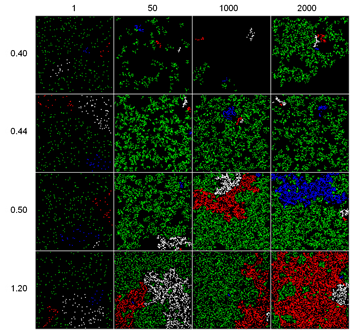
We are investigating the role of mutation parameters in driving speciation in evolutionary models. We have observed phase-transition-like behavior as the maximum mutation size is varied, on various types of fitness landscapes. Optimal clustering, which can be considered as an analog of speciation, occurs for an intermediate mutation parameter. Our first work on this model appeared in PLoS ONE. More recently, we have found similar behavior even on a neutral landscape, in which all simulated organisms have identical fitness.
NEURAL SYNCHRONIZATION
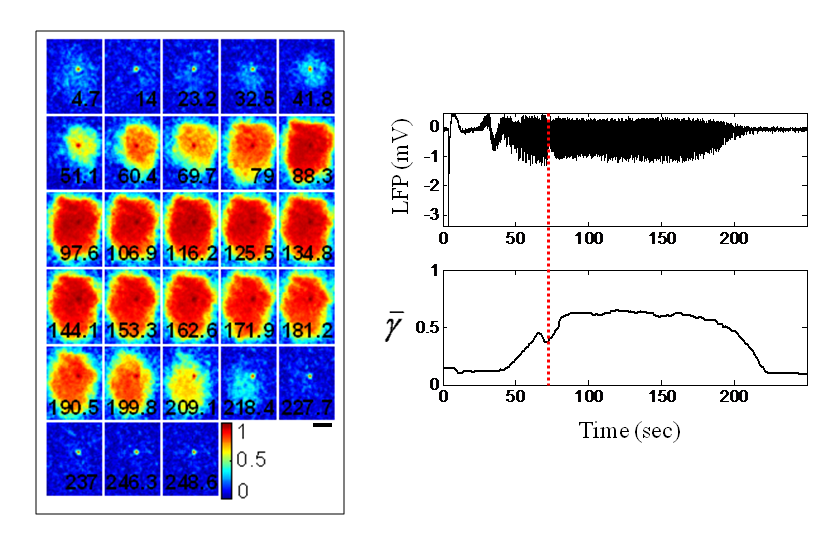
Recent doctoral student Daisuke Takeshita (Ph.D. 2010, now Associate Professor at the University of Tokyo) studied the synchronization of neural activity in the rat neocortex during focal seizures. Using voltage-sensitive-dye imaging, Daisuke demonstrated a sharp rise in synchronization during seizures. This study appeared in the journal Chaos, in a focus issue honoring Frank Moss.
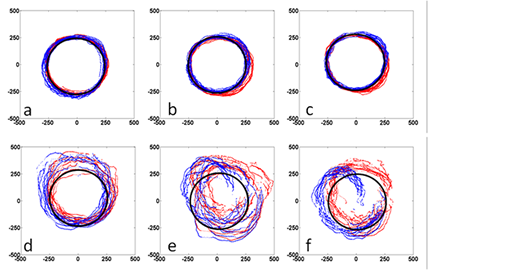
Recent doctoral student Roxana Contreras (Ph.D. 2009), studied eye-target synchronization in normal subjects and mild traumatic-brain-injured (mTBI) patients. Her most recent work in this area appeared in Brain Research in 2011.
EVOLUTION OF FORAGING STRATEGIES
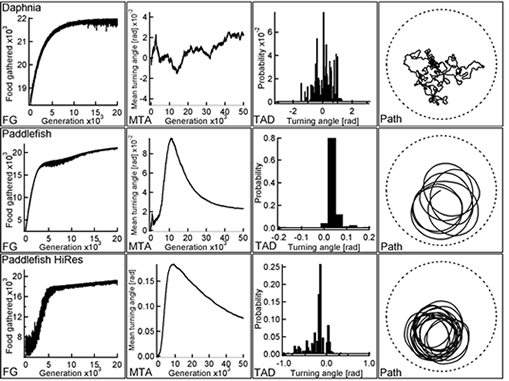
Recent doctoral student Nathan Dees (Ph.D. 2009),studied the evolution of optimal foraging behavior in various species, ranging from Daphnia to paddlefish. He also investigated how nonlinear dynamical techniques can reveal the relationship between the fMRI-BOLD signal and EEG recordings in human subjects.