
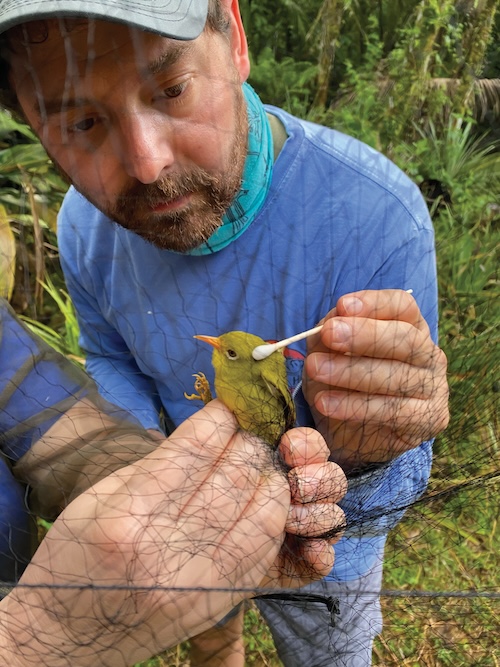
Although a conservation scientist, John Bender is as focused on people and partnerships as he is on the birds he works to protect. After earning degrees in integrative and conservation biology, the executive director of the Pacific Bird Conservation spent years on field projects across Illinois and at Chicago’s Lincoln Park Zoo, experiences that convinced him effective conservation must connect animal care, field science and local leadership. Now finishing his PhD in biology at UMSL, Bender leads community-engaged conservation across the Mariana Islands, where his team advances species recovery and ethical bird translocations. Guided by a commitment to decolonizing science, he sees his role as a conservation architect, building the trust, capacity and long-term collaborations needed to turn good science into real action on the ground.
1
Do you remember a moment that solidified your interest in bird conservation?
I’ve always loved wildlife, but birds became my focus during my first undergraduate field jobs. I realized they do more than most people think, from seed dispersal and pollination to insect control and shaping food webs, and they respond quickly to environmental change. When I started working in the Marianas, that became even clearer. Birds can play outsized ecological roles there, sometimes even as top predators. Seeing a crow or kingfisher at the top of a food web was mind-blowing, and it really shaped my career.
2
What is the decolonization of science, and why is it important?
For me, decolonizing science means shifting from doing research on communities to doing research with communities. Local leadership must be central, not just included at the margins. It means co- developing research questions, respecting local priorities and knowledge systems, sharing data and credit fairly and investing in local capacity. In island contexts especially, extractive science has caused real harm, so trust and accountability are not optional. If we want long-term conservation success, the work must be reciprocal.
3
Why did you choose to pursue your PhD at UMSL, and what has been the most exciting part of working with the Whitney R. Harris World Ecology Center?
I chose UMSL because it offered exactly what I needed: a PhD program where traditional ecological research and zoo-based conservation were not separated. The partnership among UMSL, the Harris Center and the Saint Louis Zoo created a rare, energizing network where students and professionals exchange ideas, build collaborations and translate research into real conservation outcomes.
What excites me most is how the Harris Center truly connects academic research with real conservation action. Its training, funding, mentoring and support have allowed me to bring undergraduate students to the Mariana Islands, where they gain direct experience in island ecology, field research and applied conservation. It has been incredibly rewarding to watch people grow from students into early-career professionals and effective conservation leaders.