Kristin Sobolik has often told the story of her first visit to the University of Missouri–St. Louis.
She came to town just before Thanksgiving in 2016 to interview for the role of provost and vice chancellor for academic affairs. She stayed at the Hilton Garden Inn one exit west on I-70 and took an Uber ride to campus, asking her driver to let her off on the north side, near the corporate headquarters of Express Scripts and the Mark Twain Athletic Center. She wanted to walk from one end to the other so she could get a lay of the land and have a chance to meet some of the people who made the university come alive.
Sobolik took stock of UMSL’s physical assets - treasured buildings such as the Blanche M. Touhill Performing Arts Center and the Millennium Student Center - and appreciated hearing the passion in the voices of students and staff members she encountered along her walk when she asked them about their university.
Not long after reaching the College of Nursing on South Campus, she sat down on the front steps and called her husband, Scott Peterson.
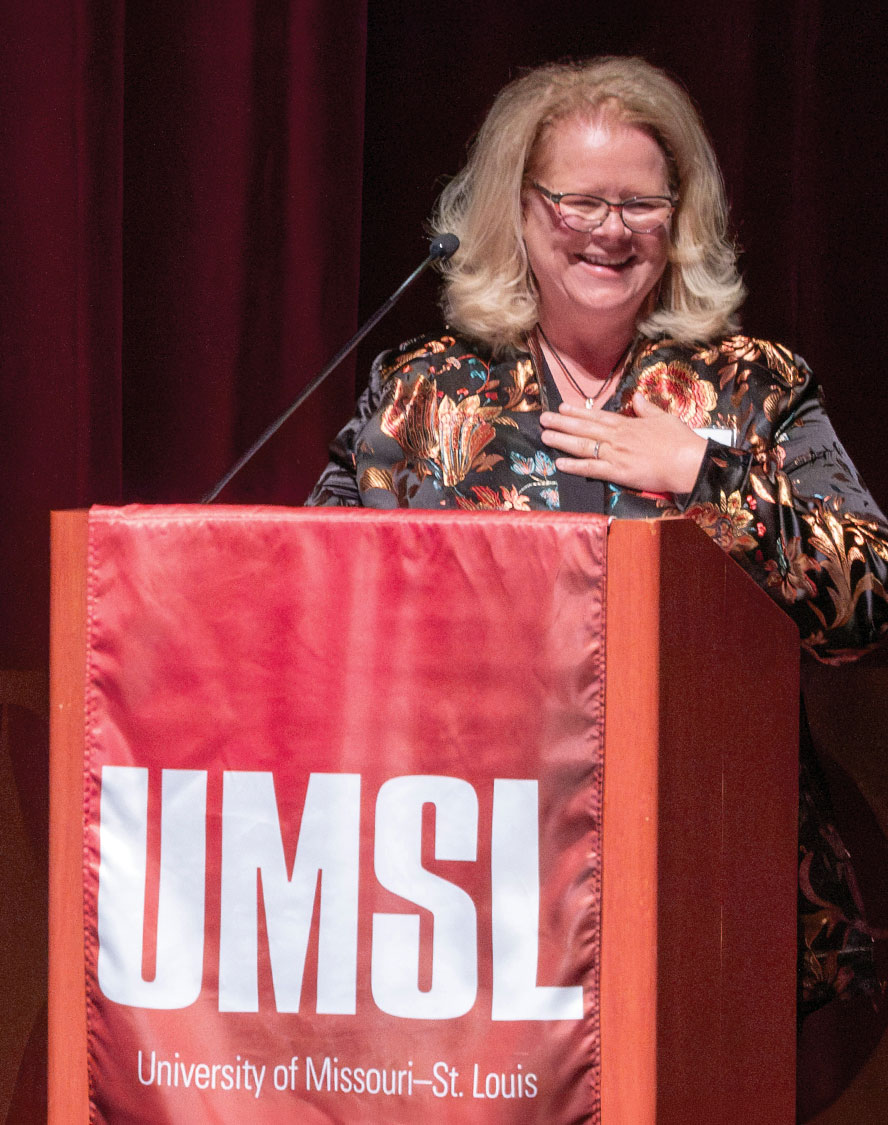
“What do I need to do to get this job?” she remembers asking him. “I wanted this job here at UMSL because of the people, because of how wonderful they were, how they loved the university, and everything that was happening here.”
But Sobolik also had a vision for what UMSL could become by leaning into its role as an anchor institution in north St. Louis County and working to drive workforce development and economic mobility across the region. Over the course of more than nine years - first as provost and then as the eighth permanent chancellor in UMSL’s history beginning in April 2020 - she helped the university embrace that role while ensuring others took notice of its regional significance. She left an indelible mark on the university - and St. Louis more broadly - when she retired as chancellor at the end of June.
Under her leadership, UMSL has fostered greater cooperation with the local business community and engaged its alumni and supporters more than ever. That engagement is a testament to the impact the university has had on their lives and further supports UMSL’s mission to transform the lives of future students.
“UMSL has gone from being important to the future of our region to becoming essential to it,” says alum and attorney Joe Blanner, a 1998 graduate in public policy administration and former president of the UMSL Alumni Association now serving as a member of the Chancellor’s Council.
UMSL has been expanding access to higher education since its founding as the first public university in the St. Louis region more than 60 years ago. While working to meet the needs of students of every background, it has excelled at unlocking opportunities for first-generation students or students from disadvantaged backgrounds.
U.S. News & World Report has recognized that work. In 2019, it named UMSL to its inaugural list of “Top Performers for Social Mobility,” which acknowledges the universities that do the best job helping Pell Grant-eligible students complete their degrees. The university has consistently been the top-ranked school in Missouri and one of the top 100 schools nationally on that list in the years since.
UMSL also has taken steps over the past nine years to make it easier for all students to earn their degrees. During Sobolik’s time as provost, the university initiated a curriculum alignment process that established clearer pathways to degree completion, helping increase graduation rates while lowering student debt.
The university has simultaneously re-examined its degree offerings and launched more than a dozen new academic programs in areas such as cybersecurity, child advocacy studies, entrepreneurship, fintech and supply chain analytics - all designed to address the needs of the ever-evolving regional workforce.
UMSL also established its Geospatial Collaborative, signed educational and research partnerships with the National Geospatial-Intelligence Agency, and began offering an undergraduate certificate in geographic information systems to help prepare students to work in St. Louis’ growing geospatial ecosystem.
In perhaps one of the most critical advancements for the university, UMSL opened its new School of Engineering in 2025 with an initial freshman cohort of more than 60 students who began working toward degrees in civil, electrical or mechanical engineering.
The university, with support from the state of Missouri, the James S. McDonnell Foundation and industry leaders such as Ameren, Boeing and Emerson, set out on a mission to improve economic mobility in the St. Louis region, while providing a solution to meet the region’s need for more skilled engineers.
“One of Chancellor Sobolik’s greatest strengths has been her ability to bring people together in support of UMSL’s mission, creating enduring partnerships and a broad network of collaborators and advocates,” Provost and Vice Chancellor for Academic Affairs Steven J. Berberich says.