
Feature
Balen Burbridge felt a bit uncertain as the past school year began.
He had just transferred to the University of Missouri-St. Louis from community college and was adjusting to the new environment while also wrestling with self-doubt after the end of a serious relationship.
But a chance encounter early in the new semester set Burbridge on a path to facing those challenges and building self-confidence. One day, making his way through the Millennium Student Center, he spotted a table that piqued his interest: Army ROTC. After a conversation about the program, he envisioned what it could do for him.
“I could see the support and strength that the Army could provide — that community,” Burbridge recalls. “On top of that, my uncle went through the Army, so I had a bit of personal connection to it. Then the benefits themselves also really interested me because I’d been trying to think of a way to save money, and here’s this program that rewards you for all the personal work you put in, and it can really, really pay off.”
Burbridge is just one of several UMSL students who benefitted from Army ROTC classes returning to campus for the 2025-26 academic year. UMSL and Gateway Battalion, which oversees Army ROTC programming at eight St. Louis-area universities, worked to revive the program’s presence at the university after a several-year hiatus that stemmed from a realignment of resources during the COVID-19 pandemic. The return eliminated a logistical hurdle because UMSL students had to travel to another university to complete ROTC courses during the pause.

You're not just being told what you should do as a leader; you're actively seeing how leadership works.
In the summer of 2025, UMSL and Gateway Battalion struck an agreement that offers a variety of financial benefits to UMSL students who join ROTC, making it possible to recruit the first new cohort of on-campus cadets in five years. Ten students, including Burbridge, completed two ROTC freshman-level classes, “Introduction to Leadership I” and “Introduction to Leadership II,” during the 2025-26 school year. Retired Col. Chad Callis, a military science instructor with Gateway Battalion, led the courses and played an integral role in acclimating the students to the program. Callis was not only impressed with the new recruits but also the buy-in from stakeholders at UMSL.
“We haven’t ever seen the level of success that we had over the last year, and I’m blown away by it,” Callis says. “It’s phenomenal. It’s that perfect combination, where we’re doing a lot of the right things to help build the program from our perspective and it’s meshing perfectly with what we’re seeing from the administration at UMSL.”
Now, UMSL and Gateway Battalion are strengthening their partnership and capitalizing on that success. This year, the university is offering the freshman-level classes again as well as sophomore-level classes, and total UMSL enrollment in the program has jumped from eight students during the 2024-25 academic year to 28. Vice Chancellor for Strategic Enrollment and Career Advancement Reggie Hill says the enhanced programming is a boon to the cadets and the broader UMSL community.
“Not only can ROTC bring another pathway for students to enroll,” Hill says, “but also it changes the fabric of the campus by infusing young future leaders to the campus who are serious and who are career-ready on Day One.”
Army ROTC, or Reserve Officers’ Training Corps, prepares college students to eventually become commissioned officers in the United States Army, the Army Reserves or the Army National Guard.
There’s initially no military service obligation to join the program. But once students do contract with Army ROTC on an officer track, UMSL will provide $1,200 for textbooks and a $6,000 housing grant for Oak Hall per academic year. Simultaneously, Army ROTC will provide a monthly allowance of $420, and the National Guard will offer monthly drill pay.
The financial benefits of the program intrigued Noah Atkinson, who had been searching for a way to reduce the cost of his college education. After graduating high school, Atkinson worked in landscaping and lawn care for a few years before an acquaintance suggested looking into the National Guard. He was prepared to pursue a standard enlistment, but a recruiter steered him toward the 09 Romeo (09R) track, which allowed him to enlist in the National Guard with the option to then become a contracted ROTC cadet. Meanwhile, Burbridge joined the program as a “class-only” student before enlisting with the National Guard in May.
Atkinson, a pre-engineering major, and Burbridge, a biology major, have gotten far more out of the program than a reduced tuition bill, though. They have both learned to persevere in the face of obstacles, solve problems effectively and communicate confidently. Callis says that’s the goal of the introductory courses. While students do learn basic soldier skills such as first aid and land navigation via a map, the courses are more about cultivating values and practices that breed good leadership.
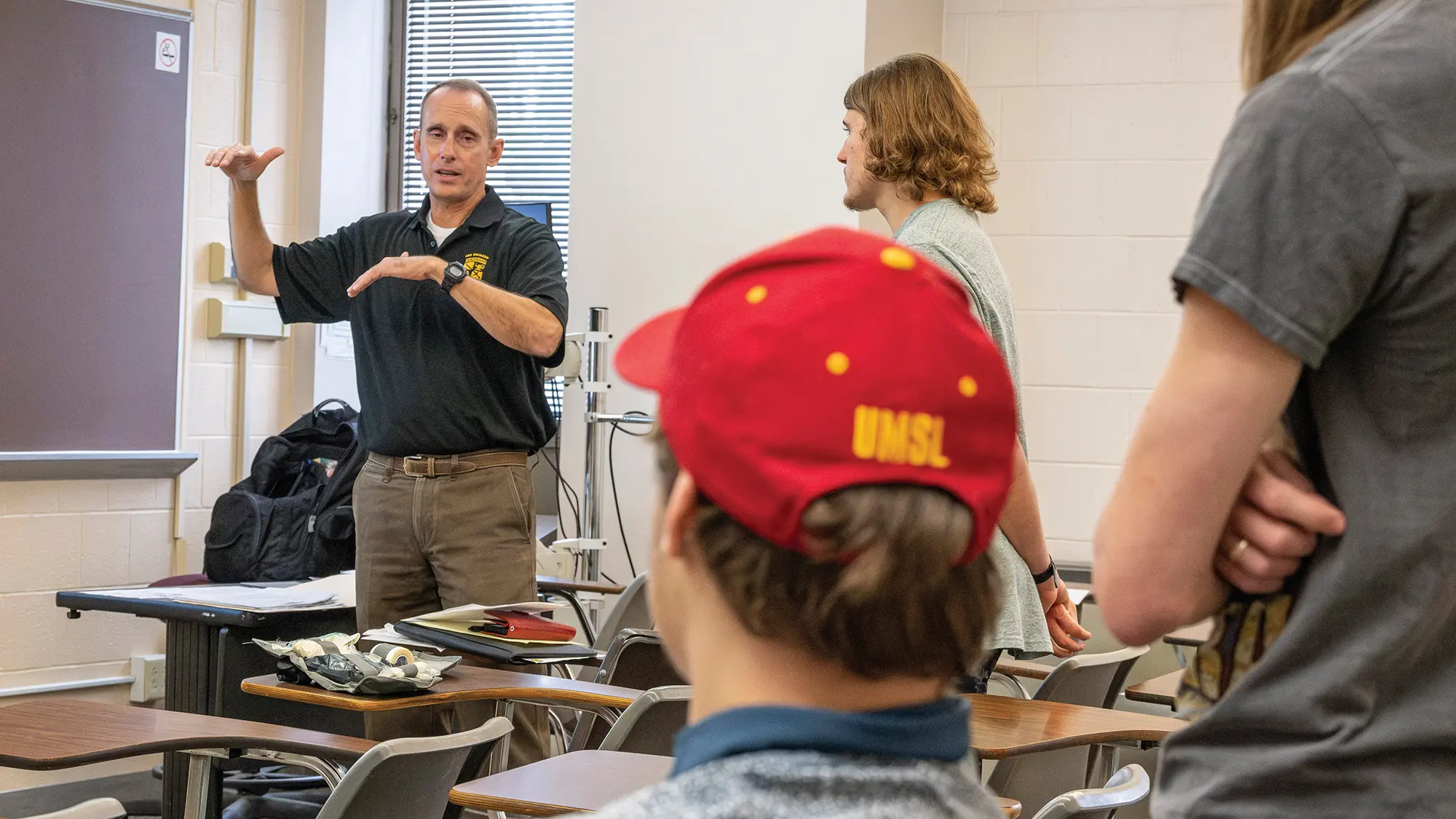
“We have what we call our leadership requirements, which are really the competencies and attributes of leaders,” Callis says. “We talk about communication, different ways for folks to communicate and how that plays out in real-world environments. We talk about critical and creative thinking. We also talk about different levels of leadership and how being a leader at, say, a strategic level in an organization is different from being at the direct level.”
Callis adds that students get hands-on experience with those concepts and start to navigate their own abilities to communicate and lead. Atkinson and Burbridge are indicative of that personal and professional development.
The leadership courses taught me how important it was to be heard and, of course, to hear other people out, too. it helped me come out of my shell and actually lead people.
Noah Atkinson
“One of the best things I took from the program was that leadership is more than just giving orders,” Atkinson says. “It’s about understanding individual people and adapting to different personalities. I don’t want to say I was shy, but I was never a big talker before. The leadership courses taught me how important it was to be heard and, of course, to hear other people out, too. It helped me come out of my shell and actually lead people.”
Burbridge saw that leadership required confidence in himself but also in his colleagues.
“I’m hands-on,” he says. “I like to make sure everything is done. A skill I had to learn is trusting people, understanding that they know the job and putting faith in them that they’ll get it done, so you can do the things that you need to do.”
Atkinson and Burbridge have utilized those insights outside the classroom as personnel managers at Five Guys and Pizza Hut, respectively. The cadets credit that understanding and real-world application to Callis’ instruction.
"He would always find a way to pull you in, to engage with you," Burbridge says. "That aspect is really important because you're not just being told what you should do as a leader; you're actively seeing how leadership works. He's actively using those skills right in front of you. You pick up on it."
Student cadets also have opportunities to employ lessons from the classroom during weekly physical training sessions and leadership labs, though they are only required for those contracted on an officer path, as well as semiannual field training exercises at Fort Leonard Wood in south central Missouri.
On Thursday afternoons, participants in the leadership labs spend about two hours engaging in practical exercises and solving problems together. Atkinson recalls a particularly memorable lab where the students role-played a mock terrorism event. Callis devised the scenario, splitting the lab in half with one group trying to force its way into a classroom while the other group worked to thwart the attack.
During the spring field training exercise, they hone their proficiency in military tactics through simulated battle situations such as assaults, ambushes and raids. The fall excursion to Fort Leonard Wood also includes confidence and obstacle courses that test the cadets' mental and physical fortitude.
"It can be grueling," Atkinson says. "It's definitely painful, especially when it's really hot. But learning to challenge yourself in that way is very productive. When you actually manage it, you get a very high feeling of accomplishment."
Over the course of last school year, Callis could see the cadets making progress before his eyes and putting the leadership lessons into practice during classes, field training exercises and leadership labs.
"I saw a lot of development, really good positive development amongst them," Callis says. "Also, I saw the freshmen start to come together as a group and really start to support one another. It's funny how students don't realize that instructors are listening. Whether it's before class or when they're doing group projects in class, listening to how they're talking to one another and how they're supporting one another, that was neat to see."
This year, Gateway Battalion fielded a new cohort of first-year cadets at UMSL and offered sophomore-level courses, Innovative Team Leadership and Foundations of Tactical Leadership. The new classes are a continuation of the previous coursework and touch on the same concepts, only with added levels of complexity and detail.
"The idea is when folks come out of what we call the basic course, which is our freshman and sophomore level, they'll be at a relatively high level of preparation, and they'll be able to go into our advanced level class for the juniors and the seniors," Callis says.
Atkinson and Burbridge both continued with the ROTC program this year after seeing the transformative change it brought to their lives.
"It really is good for self-development," Atkinson says. "You learn a lot. You change a lot. I changed a lot from where I started last year, and I hope to continue doing that."
In the future, Atkinson plans to pursue a civilian career in mechanical engineering while serving in the National Guard. Likewise, Burbridge would like to work in animal or ecological conservation and fulfill his service with the National Guard, but he hasn't completely ruled out an active-duty assignment with the U.S. Army.
Though Burbridge felt uncertain upon arriving at UMSL, he's now moving forward confident that Army ROTC has prepared him to succeed as a leader in the classroom, the military and the workforce.
"It does a really good job of training resilience, discipline," he says. "It does a good job of training you mentally to interact with people. The leadership courses give you a lot of things to consider. Even though you're on an officer track, that doesn't automatically make you a leader. There are still steps to it. There's a big difference between people who want to follow you as a leader versus people who are forced to follow you. You want people to actively follow you."
Note: UMSL student Noah Atkinson joined the program on the 09 Romeo (09R) track, which allowed him to enlist in the National Guard with the option to then become a contracted ROTC cadet.