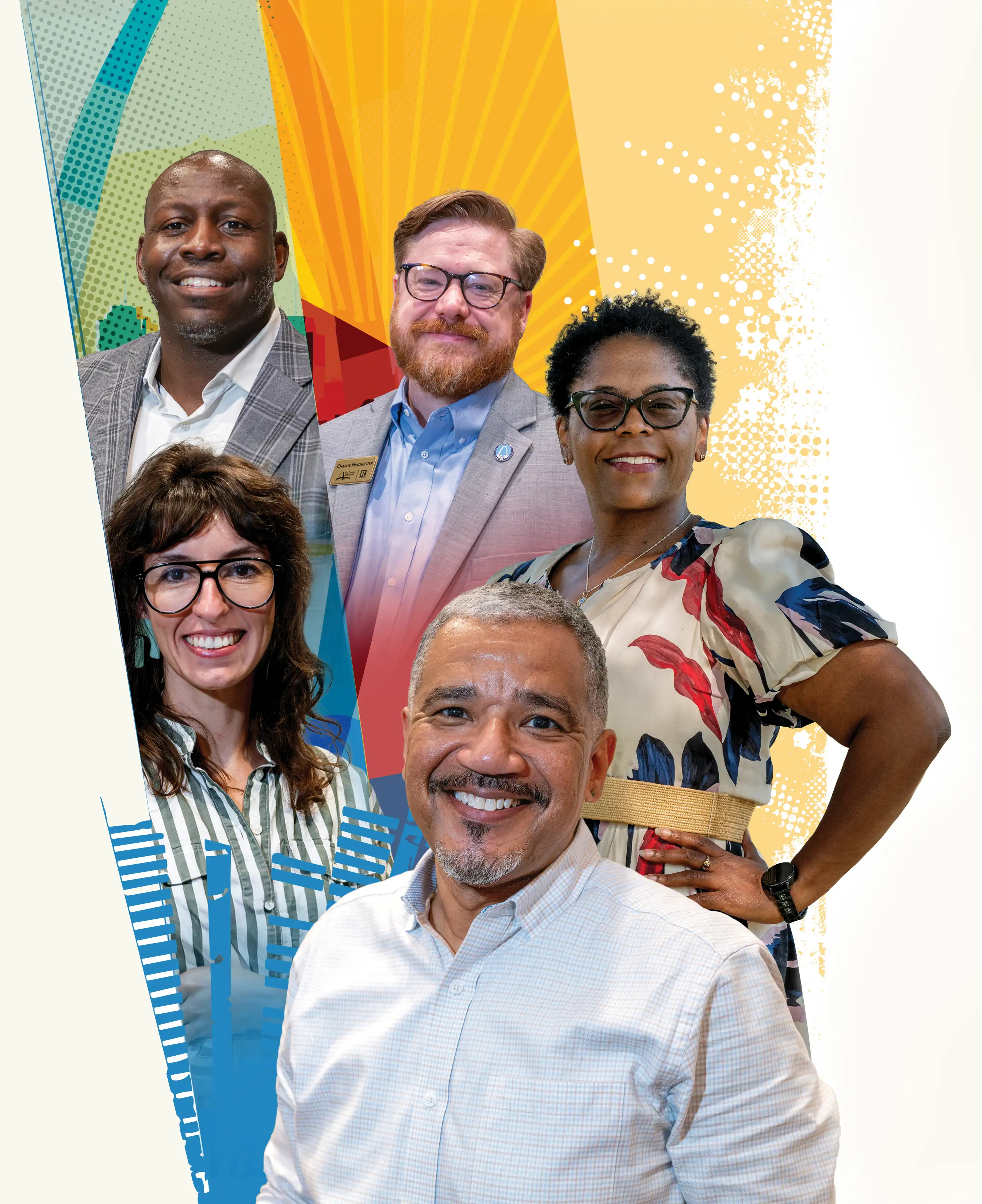
Christina L. Dancy has spent more than 25 years in the financial services industry, including several different roles that put her on the ground in the community.
Over the past decade, she served as Midwest BankCentres assistant vice president and BankCentre leader in Pagedale, Missouri, acting as a community liaison and providing financial education to local residents and business owners. From there, she moved to Edward Jones as program manager for community impact. More recently, Dancy has been an assistant vice president at U.S. Bank, where she began her career. She is responsible for developing mortgage products and digital experiences tailored to first-time homebuyers and leads strategies that expand access to homeownership.
My engagement was connecting people to resources, primarily financial education options to get them to that destination, Dancy says. That could be from homeownership, but Ive also done that from regular banking services.
After spending so much time working closely with community members, Dancy couldnt help but widen her gaze beyond the parameters of her professional role. She found herself paying attention to other areas of need in the neighborhoods in which she served and started wondering if there were different ways she might make an impact.
Dancy majored in public policy administration while earning her bachelors degree at the University of Missouri-St. Louis in 2010, so she might have been predisposed to thinking about these issues. But like a lot of community-minded people looking to get more involved, she wasnt sure of the best way to put that interest into action.
She credits the Neighborhood Leadership Academy and Neighborhood Leadership Fellows programs, organized as a partnership between UMSL and the University of Missouri Extension, for helping change that. The programs provide hands-on civic training for people looking to strengthen the places they live and work.
Over the past 20 years, UMSL and MU Extension have built a network of more than 900 Neighborhood Leadership program alumni, spread throughout the state of Missouri and beyond, who have been helping to drive positive change in their communities.
With her involvement in the 10-week NLA program in 2023, Dancy gained experience and insight into organizational management and local project planning. A year later, she completed the nine-month NLF program, designed as an advanced leadership program with a greater emphasis placed on helping participants learn how they can shape policy while giving them opportunities to network with other community leaders.
Now I can fit the pieces of the puzzle together, Dancy says. Its not just about the financial industry. That is one piece. Now I have connections with local government. I can talk to someone at a state level or even federal level in terms of how to move things forward, whether that involves programming or creating policy. Its an additional space that I can play in.
Earlier this year, Dancy even decided to throw her hat into the political realm, running for and winning elected office as the third ward councilmember in University City, Missouri.

Neighborhood Leadership Academy
The first of the programs, the Neighborhood Leadership Academy, launched in 2002 with guidance from Kay Gasen, who served as UMSLs director of Community and Neighborhood Development, and John McClusky, the founder of its Nonprofit Management and Leadership Program. Their vision was to provide practical leadership and community building training for residents and leaders across Missouri.
Claire Wolff Rippel, the education director for community development and regional economic development and director of Creating Whole Communities, has tried to stay true to those aims since she took over leadership of the program in 2016.
I have just shepherded it along, Wolff Rippel says. I try to be a good steward of the program and the ideas that were set forth.
The program is offered in an online format for participants across the state, and there remains an in-person cohort for St. Louis-area residents that meets on Tuesday evenings throughout the fall at the Regional Center for Education and Work on UMSLs campus. Training sessions focus on building leadership and organizational skills and learning about different approaches to community development. Participants discover how they can tap into their own connections to help enact change in their communities.
NLA graduates - who today number more than 700 - have created youth empowerment programs, raised funds to establish parks or community gardens, conducted neighborhood needs assessments and organized neighborhood coalitions, among many other initiatives.
The program has also achieved international reach. After about six months working with colleagues in South Africa to adapt the curriculum and ensure that it was culturally competent, Wolff Rippel and colleagues traveled to Stenden University in Port Alfred, Eastern Cape, to help with implementation.
They have a strong community development focus and saw a real need for community leadership in their surrounding communities and townships, Wolff Rippel says. Some of us traveled there to do a train-the-trainer program for the university and for some of their local community leaders.
The collaboration has continued. Wolff Rippel still meets periodically to trade notes with her counterparts in South Africa. She likes to hear about their experiences and to see what similarities exist across cultures and what lessons might be gleaned from them. The university has recently begun licensing the NLA curriculum for use elsewhere in the United States.
There have been so many great opportunities to connect with people through this leadership work, she says, because it is so fundamental to communities.
Neighborhood Leadership Fellows
Wolff Rippel always understood the importance of Neighborhood Leadership Academy to community members. Shed worked to build a place-based neighborhood leadership program at local nonprofit Grace Hill Settlement House even before coming to UMSL and had seen how hungry residents were for that type of training.
She also recognized a need to expand beyond its scope.
It was really clear what we were doing was important, she says. People were doing projects and community efforts in neighborhoods, but we werent really touching on the topic of systems change in Neighborhood Leadership Academy. Someone would say, ‘I want to start a community garden, and wed say, ‘Great, how can we help? But we werent saying, ‘Well, why is there no healthy food in your neighborhood? or ‘Why is there a vacant lot there? We werent really trying to understand the system and what could be done at City Hall or in positions of power to make change.
The Neighborhood Leadership Fellows program was conceived as a sort of NLA 2.0 to address that need. It started in 2018 with a particular focus on training people from neighborhoods in north St. Louis city and north St. Louis County that have seen decades of disinvestment because people in those communities can often struggle to have a say in actions affecting them.
There was always that barrier in the decision-making spaces, so we asked, ‘How do we support leaders to feel comfortable in that space, understand how to navigate that space and really, really affect change in their communities? says Dwayne T. James, a community development specialist and the director of access and engagement at MU Extension, who co-founded the program and leads the facilitation team.