Artists and the National Parks Movement 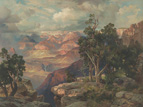
In the mid-nineteenth century, the American public became increasingly interested in the far reaches of the continent. Adventurous artists made names for themselves by documenting the newly-explored areas of the Rocky Mountains, the Sierra Nevadas, and portions of South America for East Coast audiences. Albert Bierstadt and Thomas Moran, in particular, became known for their panoramic landscapes of these grand geographic vistas. Both artists accompanied survey teams sent by the government to document the nation’s topography. Although these expeditions usually also included photographers, the black and white images they produced were unable to convey the brilliant colors of the landscape. Therefore the artists’ sketches and paintings were integral for providing an added dimension to the documentation needed for a successful expedition.
Although the painters’ views were considered documentary, it is known that each artist selected and often edited the views to create the most dramatic and beautiful composition. In addition, both Moran and Bierstadt created extremely large panoramic paintings that were meant to approximate, for the viewer, the overwhelming grandeur of the western landscape. These paintings were exhibited in cities across the country and were eagerly viewed by urban audiences who wished to vicariously experience western exploration. The images' popularity resulted in fame and success for the artists, of course, but there was another fortunate outcome from the positive public response. The beauty of these images inspired a renewed movement to preserve the American wilderness.
Moran's paintings in particular were instrumental in the establishment of Yellowstone as the first national park in 1872. Moran’s sketches were circulated through the halls of Congress and were used as tangible proof of the wonders of the Yellowstone region. They were considered the most important exhibits brought before the Congressional Committee. Only seven months after Moran’s expedition to Yellowstone, Yellowstone National Park was created, with many other national parks following soon after. It is incongruous that they were formed both to preserve the land and to encourage tourism to these areas, for now the effects of tourism have, in some areas, threatened the very wilderness that was meant to be preserved.