Interviewing and Data-Gathering Techniques
| Why Conduct Interviews? |
Types of Interviews |
Potential Interviewing Problems |
| Interviewing Guidelines |
Possible Forms of Resistance During an Interview |
In the systems development business today,
there is too much emphasis on the computers
and not enough emphasis on the business.
How to Improve It? Ask Those Who Use It
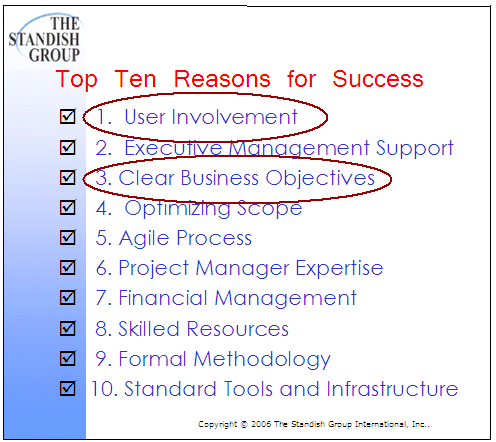
IT people need to know the business better than the business people.
- It will help you design and code programs when the interviews did not cover everything.
- It will help you know when users are asking for things that don't make sense.
IT people need to know the business of IT better than ever.
- Projects are getting bigger and bigger.
- Projects are getting more critical to business waiting for them.
Systems must be designed by the users indirectly (they must set specifications). HOWEVER, most users don't know what they want, and don't understand
their jobs very well.
Goals for an Interview
- Seek an understanding of the business and the business problems faced by the user before
designing the system
- Need information about behavior of current system or requirements for a new system
- Need to verify understanding (informal review of analysis)
Problems with Interviews
- Much information may only be available from people, even if much is available in records
- The most common problem IT have in interviewing is underestimating the complexity of the
problems faced by the users.
- Often you will find your biggest problem is getting users' time.
- Users do not realize how complicated their business is. They have not stopped and counted all
the special cases they address each day.
- Users perceive this phenomenon as "You are not listening to me!"
- Often only the first couple of problems or cases mentioned by the user are solved rather than
solving everything at once.
This phenomenon results in systems that do some things very well, but do not actually solve the
business needs.
- Plan the interview.
- Prepare interviewee: appointment, priming questions.
- Prepare agenda, checklist, questions.
- Listen carefully and take notes (tape record if permitted). Note difficulty with sending cues to the interviewee.
- Review notes within 48 hours.
- Be neutral.
- Seek diverse views.
- Interviews: live, face-to-face, with written notes (may be taped)
List of questions is an "interview schedule"
Costly approach
Good for getting detail from a few people
Good for situations where probes are necessary
- Surveys or questionnaires: pen and paper or computer-based inquiry
More economical approach
Good for gathering information from many people, or people in different locations
Good to get overall opinions of users
The Interviews/questionnaires should supplement information gained in
- Vendor Presentations
- Visits to Other Installations
- Data Collection
- External Research
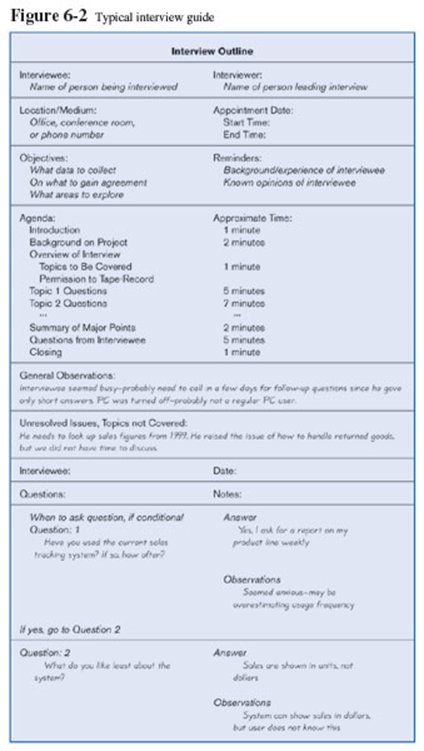
Each question in an interview guide can include both verbal and non-verbal information.
- Open-ended questions: questions that have no prespecified answers.
- Closed-ended questions: questions that ask those responding to choose from among a set of specified responses.
- Asking the wrong questions and getting the wrong answers
- Interviewing the wrong people at the wrong time
- Creating bad feelings between parties
- Interview several key people together
- Advantages
- More effective use of time.
- Can hear agreements and disagreements at once.
- Opportunity for synergies.
- Disadvantages
- More difficult to schedule than individual interviews
- Contradictions and inconsistencies between interviewees.
- Follow-up discussions are time consuming.
- New interviews may reveal new questions that require additional interviews with those interviewed earlier.
- Develop an Overall Interview Plan
-
- Get an organizational chart
- Determine who you need to speak to (clerical, managerial, executive)
- Speak to people in the right order
- Don't waste people's time!
- Obtain Approval to Talk to the Users
-
- Managers may want to choose the right people
- Managers may want to avoid the wrong people
- Managers may want to protect their workers' time
- Managers may want to avoid personal issues
- Managers may want to avoid political issues
- Plan to Make Effective Use of Time
-
- do work up front over the phone, email, ...
- prepare a meeting agenda, questions (circulate in advance)
- keep the interview to an hour or less
- schedule a follow-up meeting to review material gathered
- Use Automated Tools, but Don't Overdo It
-
- use tools if they help all the parties
- share tools with appropriate parties
- don't let tools become a bottleneck to progress
- Determine What the User in Interested In
-
- let the users say what they want in an interview
- use that information to estimate priorities
- Use an Appropriate Interviewing Style
-
- ask about relationships
- ask different people for alternative viewpoints
- probe for more detail when needed
- ask about dependencies among data, processes, people
- try paraphrasing what you interpret
to see if you are understanding what people are saying
- You're taking up too much of my time.
- You're threatening my job.
- You don't know our business, so how can you tell use what the new
system should look like?
- You're trying to change the way we do things around here.
- We don't want this system.
- You're wasting our time asking these questions;
what we want should be obvious.
Other Potential Problem Areas:
- Discussion that focuses more on implementation than requirements
- Confusion between symptoms and problems
- Users who are unable to say what they want or change their mind
- Disagreements among users, managers, ...
Rules of Thumb for an Interview
- Break in and ask questions if you have them.
- Do not take too many notes.
- Listen, listen, listen.
|