Sound Bytes: nanocones from space |
star smoke | red giant onion cores | graphene rain | early days of life's
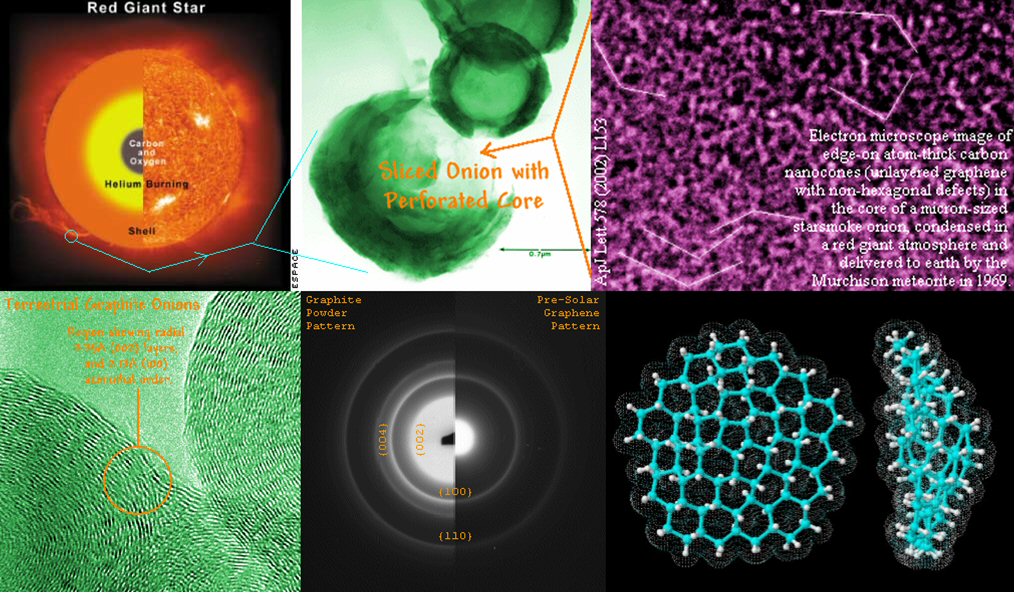
atoms We suspect this is the first close look at naturally-occuring unlayered but solidified graphene (hexagonal carbon nets, layers of which make up the graphite in pencils). This unlayered graphene is found in the center of carbon spheres (about the size of a human blood cell) which were extracted from the Australian meteorite Murchison. Each sphere contains atoms manufactured in the red giant star* from which it began its journey to earth. In addition to providing information about precipitation processes (e.g. storms) in the atmosphere of red giants, such unlayered graphene may comprise much of the carbon in the interstellar medium, and be part of the history of carbon atoms in life-forms as well. Man-made counterparts of this material include bulk assemblies of single graphene-sheet carbon molecules like fullerines, single-walled carbon nanotubes, and single-walled carbon nanohorns. The selective laboratory production of the latter was only recently reported, in a paper whose data suggested a possible role for liquid carbon in the efficient formation of such structures. Since carbon has a higher melting temperature than any other solid known, an intriguing possibility not yet carefully considered is that the cores condensed as droplets of liquid carbon, where they were allowed to cool in the star's atmosphere less quickly than they might cool on earth, before being coated with graphite and ejected by radiation pressure into the interstellar medium. /pf 2002oct02
* Incidentally, isotopic studies indicate that this meteorite contains intact particles from stars formed at wide-ranging times during our ten billion year old Milky Way's first five billion years. Odds are therefore that the atoms inside you, the reader, have similarly wide-ranging origins even if they were long ago separated from ``sibling atoms'' which made the trip with them here from the star in which their nuclei were assembled from smaller parts.
Headings: circumstellar matter | dust,extinction |
meteors,meteoroids | molecular processes | stars:carbon | stars:mass loss"Laboratory evidence of slow-cooling for carbon droplets from red-giant atmospheres (2016) Microscopy and Microanalysis 22:S3 (in press) pdf.
This paper compares numerical models for solidified liquid carbon to experimental data on presolar onion cores, with help from our on-line electron phase contrast simulator. It then makes the case that cooling rates for these starsmoke particles will be slow compared to numerically-modeled times, but that the evaporating oven strategy illustrated in our poster last year still holds some promise for reproducing the faceted pentacone structures inferred from the presolar particle studies.
"Analogs for Unlayered-Graphene Droplet-Formation in Stellar Atmospheres" by P. Fraundorf, Melanie Lipp and Taylor Savage (2016) Microscopy and Microanalysis 22:S3, 1816-1817 pdf hal-01356394.
This paper reframes the low-pressure carbon-droplet formation process as one that is expected, in light of what we know about supercooling of metallic liquids in containerless settings. This is consistent with the fact that presolar onions with identifiable "carbide nucleation seeds" do not have unlayered graphene cores. The paper also provides an update on progress in our group at characterizing and modeling these unlayered graphene cores, and describes an "evaporating-oven" strategy for the slow-cooling of carbon vapor in hopes of synthesizing similar core-rim onions in the lab.
A special instance of our mobile-friendly JS/HTML5 TEM simulator* has been set up to examine various forms of disordered carbon on-line. Can YOU tell (after correcting for astigmatism and optimizing focus) which unknown contains faceted nanocones?
* cf. P. Fraundorf, Stephen Wedekind, Taylor Savage and David Osborn (2016) "Single-Slice Nanoworlds Online", Microscopy and Microanalysis 22:S3, 1442-1443 pdf hal-01362470.
"Zero-loss/deflection map analysis" by P. Fraundorf, K. Pisane, E. Mandell, and R. Collins (2010), Microscopy and Microanalysis 16:S2, 1534-1535 pdf arXiv:1203.6342.
This paper describes a robust method for mapping the inelastic mean free path "thickness" of a TEM specimen. Although interpretation is simpler if the specimen is non-crystalline, the paper also provides some data on two presolar graphite-onion core-rim specimens in the process.
"Electron beam characterization of carbon nanostructures" by Eric Mandell (2007) is the topic of a dissertation in partial fulfillment of the requirements for a Ph.D. in Physics and Astronomy at UM-StL and UM-Rolla link.
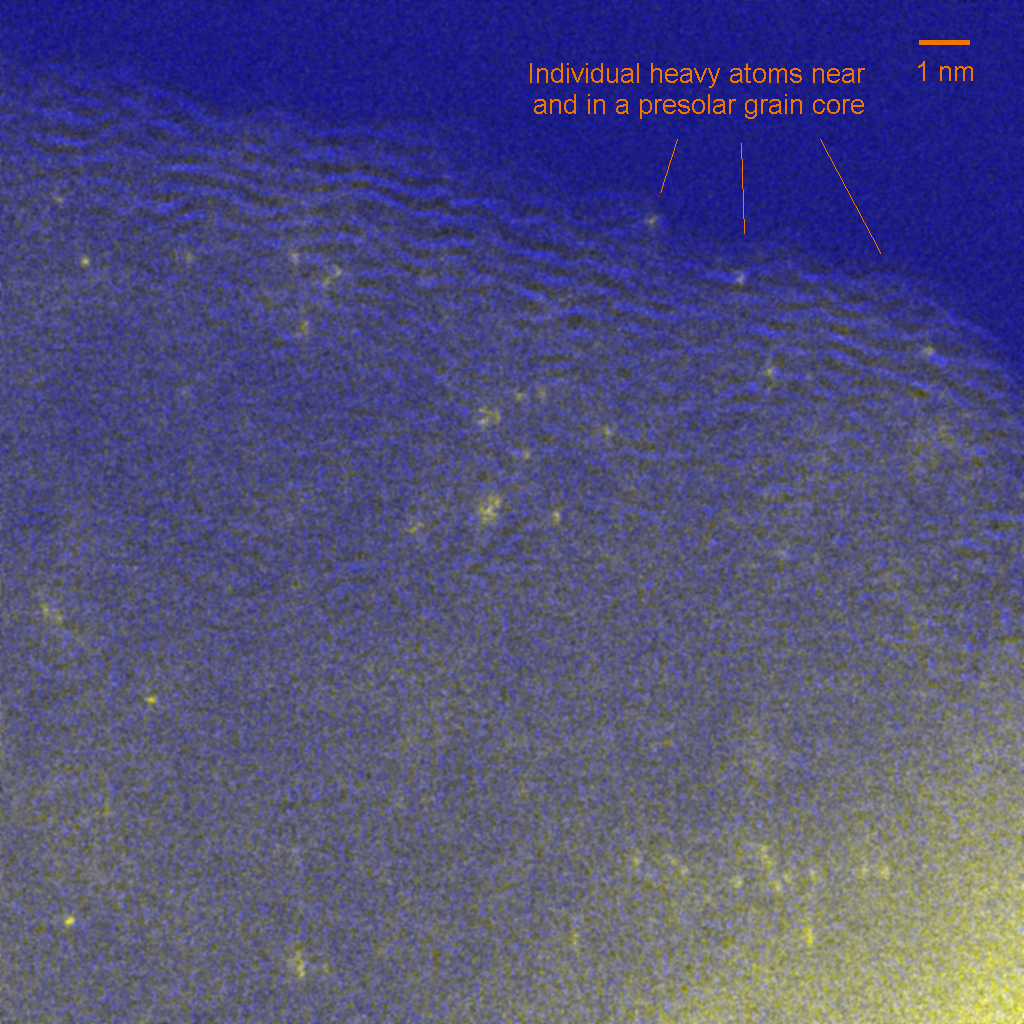
"Coherence Effects in Electron Diffraction from Presolar Graphenes" by E. Mandell and P. Fraundorf (2006) Microscopy and Microanalysis 12:S2 (Cambridge University Press) 596-597 link pdf.
This paper discusses subtle differences in electron powder-diffraction profiles which may arise from systematic (e.g. faceted pentacone) relationships between graphene sheets, as a possible explanation of differences in the experimental powder-diffraction profiles from unlayered graphene cores discussed in the paper below.
Our earlier webpage on molecule spatial harmonics has some illustrations that may be relevant in this context.
"Unlayered graphenes in red-giant starsmoke" by Eric Mandell, Nathaniel Hunton, P. Fraundorf (2006) arXiv:cond-mat/0606093.
This note describes a careful look at experimental electron-diffraction power-diffraction profiles from these unlayered graphene course, and at ways to model the profiles with a variety of techniques.
"The core structure of pre-solar graphite onions" Ap. J. Lett. 578(2) (2002) L153-156 by P. Fraundorf and Martin Wackenhut, 20 Oct 2002 (c) American Astronomical Society (posted with permission)
pfmw.onioncores eprint PDF (prior to revision clarifying the astrophysical context)
BiBTeX reference:
@article{pfmw.onioncores,
author = "P. Fraundorf and Martin Wackenhut",
title = "The core structure of pre-solar graphite onions",
journal = "Astrophysical Journal Letters",
volume = "578",
number = "2",
pages = "L153-L156",
year = "2002",
eprint = "arXiv:astro-ph/0110585"}


Some earlier slides on materials astronomy may be found here. Some earlier student reports may be found here.
Even earlier work focused on interplanetary dust collected in the earth's stratosphere, as in:
P. Fraundorf (1981) "Interplanetary dust in the transmission electron microscope:
Diverse materials from the early solar system" Geochim. Cosmochim. Acta 45, 915-943,
P. Fraundorf, D. E. Brownlee, and R. M. Walker (1982) "Laboratory studies of interplanetary dust",
in Comets (ed. L. Wilkening, U. Arizona Press, Tucson) pp. 383-409, and
J. P. Bradley, D. E. Brownlee and P. Fraundorf (1984) "Discovery of nuclear tracks in interplanetary dust",
Science 226, 1432-1434.
Later we turned our attention to presolar silicon carbon and nanodiamonds, from meteorites, as in:
T. Bernatowicz, G. Fraundorf, T. Ming, E. Anders, B. Wopenka, E. Zinner and P. Fraundorf (1987)
"Evidence for interstellar SiC in the Murray carbonaceous meteorite" (including a lattice-image micrograph on
the Christmas-issue cover), Nature 330, 728-730, and
P. Fraundorf, G. Fraundorf, T. Bernatowicz, R. Lewis and T. Ming (1989) "Stardust in the TEM",
Ultramicroscopy 27:9, 401-412.
More recently, our focus has been on the unlayered graphene cores of a subset of presolar graphite onions likely condensed in the atmosphere of asymptotic giant branch stars, after carbon nuclei synthesized in the star have been dredged up to the surface.
HRTEM of unlayered graphene from the atmosphere of red giants
P. Fraundorf and N. Hunton
Physics and Astronomy and Center for Molecular Electronics
University of Missouri-StL, St. Louis MO 63121
A paper to be published in the 20 October 2002 issue of ApJ Letters [1] discusses electron phase contrast imaging of an unlayered graphene phase which makes up the core of a subset of micron-sized "presolar" graphite-rimmed spheres. By "presolar", we mean particles extracted from meteorite dissolution residues (in this case the carbonaceous chondrite Murchison which fell in Australia in 1967) that show isotopic evidence of formation in the neighborhood of other stars prior to the origin of our solar system. The paper suggests that single graphene sheet defects in the onion cores (e.g. cyclopentane loops) may be observable edge-on by high-resolution electron microscopy (HRTEM) via the conical deformation that they cause to the graphene sheet in which they reside. This could allow better evaluation of models for their formation. Since much of the mass-loss from carbon-rich red giants might be in even smaller interstellar particles (too small to make it into meteorites during the early days of our solar system), a significant amount of interstellar carbon may be in this form.
Here we review these observations, and discuss the relevance of this natural source for unlayered graphene in context of recent laboratory developments, particularly on the efficient bulk manufacture of single-walled carbon nano-horns [2]. Prospects will be discussed (hopefully with group participation) for a possible role in both cases of a carbon liquid phase, for astrophysical simulations of condensation in stellar atmospheres, for discovery and/or preparation of terrestrial analogs, and for future imaging, diffraction, spectroscopy and decomposition studies of this extraterrestrial graphene.
Section: Astronomy Education/Frontiers in Astronomy
(Invited)

Since 1980 extraterrestrial bodies directly involved in
the night sky's appearance have been identified on earth. These include
particles from the dust cloud around our sun, collected in the earth's
stratosphere
** cf. Analysis of Interplanetary Dust, AIP Conf. Proc. 310 (eds. Zolensky, Wilson, Rietmeijer & Flynn, Amer. Inst. of Physics, NY, 1994); J. P. Bradley, S. A. Sandford and R. M. Walker, Interplanetary dust particles, in Meteorites and the Early Solar System (eds. J. F. Kerridge and M. S. Matthews), U. Ariz. Press, Tucson AZ, 861-895 (1988); D. E. Brownlee, Cosmic Dust: Collection and Research. Ann. Rev. Earth Planet. Sci. 13 (1985) 147-173; P. Fraundorf, D. E. Brownlee and R. M. Walker, Laboratory studies of interplanetary dust, in Comets (ed. L. Wilkening), U. Ariz. Press, Tucson AZ, 383-409 (1982).
*** cf. Astrophysical Implications of the Laboratory Study of Presolar Materials, AIP Conf. Proc. 402, (eds. Bernatowicz and Zinner, Amer. Inst. of Physics, NY, 1997); Zinner E., Interstellar grains from primitive meteorites: New constraints on nucleosynthesis theory and stellar evolution models, in Nuclei in the Cosmos III, (ed. M. Busso, R. Gallino and C. M. Raiteri), AIP, New York, 567-579 (1995). See also the current (Dec '97) Physics Today article on Ancient Stardust in the Laboratory, by T. Bernatowicz and R. M. Walker.

Examine unlayered graphene grown in digito on our Live3D models page.
Our first extraterrestrial materials paper may have been a paper on TEM detection of nuclear tracks in meteoritic chromite, and other minerals, by P. Fraundorf (1978) "The detection of latent nuclear particle tracks in some common minerals with conventional TEM", Electron Microscopy 1978 Volume 1 - Physics: Papers presented at the Ninth International Congress on Electron Microscopy, (Microscopical Society of Canada, University of Toronto), pages 480-481.
Parody of "Twinkle, twinkle, little star" adapted from the August 2001 Physics Today, but whose replacement of diamond with "gem carbonaceous" might be construed as a clue to the presence of stardust in carbonaceous chondrites (by an unknown author):
A cartoon from colleages at Johnson Space Center, prepared after reports of the first closeup look at interplanetary dust particles collected in the earth's stratosphere. Was this penned by Pogo cartoonist Walt Kelly?

John Dryden (1631-1700) offered this possible inspiration toward further work on tiny dark objects that have traversed (intact) the soundless aeons of interstellar space: