English 5950 Seminar in Special Topics
F. GRADY FALL 2010
455 LUCAS [Sec. G01, #13902]
516-5592 M 7:00-9:30
fgrady@umsl.edu 450 LUCAS
W 2:00-4:00, Th 1:00-3:00,
and by appointment
1939: HOLLYWOOD'S GREATEST YEAR
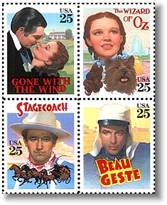 In 1990 the U.S. Post Office issued commemorative
stamps honoring four classic American films: Gone with the Wind, The
Wizard of Oz, Stagecoach, and Beau Geste.
It was hardly a coincidence that all four films had originally been released in
1939, for that year has widely been regarded as "Hollywood's greatest
year," during which the major film studios finally shook off the effects
of the Great depression, reaching new heights in employment and drawing in 40
to 50 million patrons a week to see what most students of American film
consider to be some of the best movies ever made in Hollywood.
In 1990 the U.S. Post Office issued commemorative
stamps honoring four classic American films: Gone with the Wind, The
Wizard of Oz, Stagecoach, and Beau Geste.
It was hardly a coincidence that all four films had originally been released in
1939, for that year has widely been regarded as "Hollywood's greatest
year," during which the major film studios finally shook off the effects
of the Great depression, reaching new heights in employment and drawing in 40
to 50 million patrons a week to see what most students of American film
consider to be some of the best movies ever made in Hollywood.
Of course, some of this is just
standard entertainment industry hoopla, at six decades' distance--Hollywood was
the first to
break the
good news about Hollywood's artistic triumphs in 1939. And if that year marked
a pinnacle of one sort, it was also the
beginning
of the end for the studio system that had dominated the film industry for a
generation: the European markets which
had
traditionally provided Hollywood with a good quarter of its income were about
to be lost to World War II, and soon after the
war
the studios finally lost the fierce battle against antitrust legislation that
they had waged for two decades. Even the most
successful
film of 1939 (indeed, the most successful film ever to that point), Gone with the Wind, can be seen as the
precursor of
the
blockbuster event-movie that dominates the cinema industry of our day, an
industry very different in organization from the
system
that governed American filmmaking in the 1930s.
In this course we'll try to see what
the hoopla was all about by studying several films from that great year. Along
the way
we'll
also learn something about the entertainment industry and the studio system,
1930s American cultural history, film language
and
technology, film stars and genres, and film theory and criticism. We'll be
"taking Hollywood seriously," as one of your textbooks
puts
it, as a site of artistic, cultural, social, economic, and imaginary
importance, both then and now.
Course
Requirements: Two short 5-6 page
essays, 15% each ; two 500-word
film reviews, 7 ½ % each ; final 12-15 page seminar paper, 35%; class
grade, 20% (including attendance, participation, occasional writing
assignments, and posting
on the class discussion board according to the schedule we’ll establish).
Required texts:
• Edward Buscombe, Stagecoach. British Film Institute, 1992
• Tino Balio, Grand Design: Hollywood as a Modern Business Enterprise, 1930-1939. History of the American Cinema, vol. 5. Charles Scribner's Sons, 1993. (hence GD)
• Richard Maltby, Hollywood Cinema. 2nd ed. (Blackwell, 2003). (hence HC)
• Salman Rushdie, The Wizard of Oz. British Film Institute, 1992
Tentative Syllabus:
W AUG 25 Introduction; coming attractions
Topics: some film technique and vocabulary
Reading: "Taking Hollywood Seriously," HC 6-32 (also on MyGateway)
W SEP 1 Studio production
Topics: studio production; Hollywood style; America during the Depression
Reading: "Industry 1: to 1948," HC 113-58
"Introduction," GD 1-12
"Surviving the Great Depression," GD 13-36
"Feeding the Maw of Exhibition," GD 73-108
"Technological Change and Classical Film Style," GD 109-42
Levine, “American Culture and the Great Depression” (MyGateway)
Rauchway, “Americans in the Great Depression” (MyGateway)
W SEP 8 Dodge City (1939; 105m); Destry Rides Again (1939; 94m)
Topics: Genre in film; what we know about the Western
Reading: "Entertainment 1 &2," HC 33-73
"Genre," HC 74-110
Altman, “A Semantic/Syntactic Approach to Film Genre” (MyGateway)
W SEP 15 Stagecoach (1939; 96m); Jesse James (1939; 105m)
Topics: Genre
(cont.); Ford and the idea of the auteur
Robin Wood, "Ideology, Genre, Auteur" (MyGateway)
Neale, “Questions of Genre” (MyGateway)
W SEP 22 Gone With the Wind (1939; 232m)
Topics: the prestige picture; Hollywood and the Civil War
“Space 1 & 2,” HC 312-67
"Narrative 1," HC 452-70
W SEP 29 GWTW (cont.); Judge Priest (1934; 71m)
Topics: Hollywood and race; the publicity industry
Reading: “Selling Stars,” GD 143-78
“Performance 1,” HC 369-92
***Essay
1A due date***
W OCT 6 Murder Over New York (1940; 65m); Love Finds Andy Hardy (1938; 92m); Mr. Wong, Detective (1938; 70m)
Genre V: the B picture; race (cont.)
Rzepka, “Race, Region, Rule: Genre and the Case of
Charlie Chan” (MyGateway)
Kim,
“Images of Asians in Anglo-American Literature” (MyGateway)
Lepore, “Chan, the
Man” (MyGateway)
***Essay 1B due date***
W OCT 13 Ninotchka (1939; 110m)
Topics: Comedy; Movie stars; gender and film (Ninotchka.ppt)
Reading: "Comedy," GD 256-80
Dyer, “Heavenly Bodies: Film Stars and Society” (MyGateway)
Holmes, “The Hollywood Star System and the Regulation of Actors’ Labor, 1916-1934” (MyGateway)
Mulvey, “Visual Pleasure and Narrative Cinema” (MyGateway)
W OCT 20 Dark Victory (1939; 106m)
Topics: gender (cont.); the "woman's picture"; melodrama (LINKS)
Reading: "The Woman's Film," GD 235-55
Mulvey, “Afterthoughts…” (MyGateway)
Williams, “Melodrama Revised” (MyGateway)
W OCT 27 Only Angels Have Wings (1939; 122m) (LINKS)
Topics: The Production Code
Reading: "The Production Code and the Hays Office," GD 37-72
“Narrative 2,” HC 471-90
"Criticism," HC 493-525
Inglis, “Self-Regulation in Action” (MyGateway)
W NOV 3 The
Wizard of Oz (1939; 155m) (LINKS)
Topics: MGM and the spectacular
Reading:
Rushdie, The Wizard of Oz
"Time," HC 413-51
***Essay
2A due date***
W NOV 10 Mr. Smith
Goes to Washington (1939; 130m) (LINKS)
Topics: Hollywood and politics
Reading: "Politics," HC 268-303
Levine, “Hollywood’s Washington” (MyGateway)
Capra, from The Name Above the Title (MyGateway)
***Essay 2B due date***
W NOV 17 Young
Mr. Lincoln (1939; 100m) (LINKS)
Topics: the biopic; Hollywood and history; film theory and studio production
“Theories,” HC 526-56; reread 436-48, from “History as a Production Value”
Reading: "John Ford's Young Mr. Lincoln, a Collective Text by the Editors of
Cahiers du Cinema" (MyGateway)
W DEC 1 The
Grapes of Wrath (1940; 129m) (LINKS)
Topics: the social problem film; Hollywood and the Depression revisited
Reading: "Social Problem Films," GD 280-98
W DEC 8 ??
W DEC 15 Final
essays due
SPECIAL CONSIDERATIONS: Students with disabilities of any sort who believe that they may need special accommodations in this class are encouraged to contact the Disability Access Services Office in 144 Millennium Student Center at 516-6554 as soon as possible to ensure that such accommodations are arranged in a timely fashion.