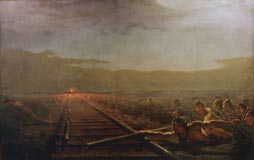
In mid-1862, President Abraham Lincoln signed the Pacific Railroad Act which authorized the Central Pacific railroad to build east from Sacramento and the Union Pacific to build west from Omaha. The job was not easy. Both railroads had to cross rugged terrain, desert and mountains and both had to deal with harsh weather. At times the greatest danger came from the Indian raids as the railroads intersected the Native Americans’ land. The Indians attacked the crews in order to protect their homeland. The effect of the railroad on the bison population also had a significant affect on the native populations and on the frequency of the attacks. As the railroad proceeded westward it allowed hunters easier access to the huge herds of bison living on the plains. The bison provided a major source of food, clothing and shelter for the Plains Indians; the devastation wrought by white hunters drastically reduced this vital element of the native people’s existence. Thus the destruction of the bison put an end to much of the hostilities that existed as the Native Americans were eventually forced out of their territory by necessity.
There was a chronic labor shortage throughout the project. Because of this, many of the workers were immigrants, in particular Irish and Chinese or veterans of the Civil War. By the second year of work, nine out of ten workers on the Central Pacific line were Chinese. The railroad workers were paid, on average, a dollar a day. They lived in twenty railroad cars, including dormitories and an arsenal car containing a thousand loaded rifles. They worked hard and were usually able to lay from one to three miles of track per day depending upon the available materials. The peak of production saw eight and a half miles laid in one day. The crews worked seven days a week, 12 to 16 hours a day. The little free time that they had they spent in drinking, partying and fighting. Murders outnumbered accidental deaths four to one in the camps.
Winter weather was one of the hardest and most underestimated problems. In the winter of 1866 it took nearly half of the work force of 9,000 men just to keep the track shoveled. Crews finally constructed wooden snow sheds around the track enabling them to make actual progress on the line. However they still had to deal with frostbite, pneumonia, inadequate shelter and avalanches of snow.
The Golden Spike, driven into Promontory Point, Utah, in 1869 marked the joining of the Western Pacific and the Union Pacific railroads. The final completion of this transcontinental line connected the two coasts and dramatically changed the country’s history. It now took only ten days to travel from New York to California. Coast to coast settlement and faster movement of products changed American life forever.