John G. Blake, Professor, Biology
  John G. Blake, Professor, Biology
 Email: blakej@msx.umsl.edu
B.A. Prescott College, Prescott, Arizona. May 1974.
M.S. University of Nevada, Las Vegas, Nevada. May 1977.
Ph.D. University of Illinois, Urbana, Illinois. January 1983.
Research Interests
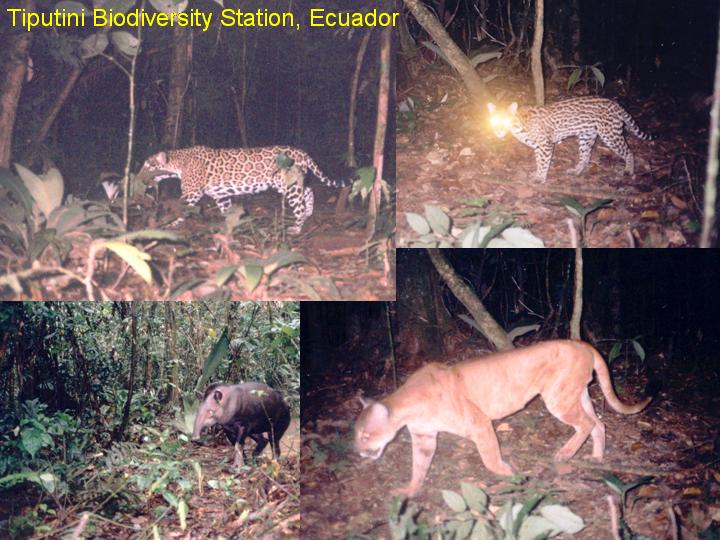
My research focuses on the structure and organization of bird communities, primarily in tropical forests. I am particularly interested in the impact of resource abundance (e.g., fruit) on temporal and spatial variation in bird populations, spatial patterns of diversity, and effects of habitat alterations on bird populations. The current focus of tropical work is in Ecuador, at the Tiputini Biodiversity Station (~0o 38' S, 76o 08' W), where we have several ongoing projects. One project focuses on spatial and temporal patterns of bird diversity (as well as aspects of community composition, population dynamics, and movement) within and between two 100-ha study plots. The Station was established in 1994 by the Universidad San Francisco de Quito on a tract of undisturbed forest within the ha Yasuní Biosphere Reserve. We established the two 100-ha plots in terra firme forest in February 2001. (A protocol has been established for use of these plots for other researchers.) We use a combination of mist nets and direct observations to record the occurrence and locations of birds within the two plots. A second major project focuses on reproductive success in manakins (Pipridae). A third project, carried out in collaboration with many people at the station, is a camera-trapping program focused on large terrestrial mammals (see article in El Comercio). We have camera traps established along trails, on the plots, and at saltlicks (saladeros). Students in my lab have come from a variety of countries (e.g. Argentina, Bolivia, Brazil, Chile, Colombia, Guatemale, Luxembourg, Peru, Uruguay, United States, Venezuela).
Teaching
Courses taught at UM-St. Louis include Ornithology, Wildlife Conservation and Ecology, Tropical Ecology and Conservation, and Biometry. In addition, I teach courses on avian ecology and multivariate analyese through Laboratorio de Investigaciones Ecológicas de las Yungas, Universidad Nacional de Tucumán, Argentina. Avian ecology courses are co-taught with Piter Blendinger, LIEY and CONICET. The course, Ecología y Conservación de Aves en el Cono Sur, is a two-week field-based course that visits several sites in northwestern Argentina. We typically have fifteen students from countries throughout South America.
Selected Publications
2008 - Blake, J. G., and B. A. Loiselle. Species richness of Neotropical understory bird communities: local versus regional perspectives based on capture data. Biotropica 40: in press.
2008 - Blake, J. G., and B. A. Loiselle. Estimates of apparent survival rate for forest birds in eastern Ecuador. Biotropica 40:485-493.
2008 - Blendinger, P., B. Loiselle, and J. Blake. Effectiveness and efficiency of fruit removal by manakins (Aves: Pipridae) from two tropical melastomes (Miconia fosteri and Miconia serrulata). Oecologia DOI 10.1007/s00442-008-1146-3
2008 - Hidalgo, J. R., T. B. Ryder, W. P. Tori, R. Durães, J. G. Blake, and B. A. Loiselle. Nest architecture of three manakin species in lowland Ecuador. Cotinga 29:57-61.
2008 - Loiselle, B., P. M. Jorgensen, T. Consiglio, I. Jimenez, J. Blake, L. Lohman, O.-M. Monteil. Predicting species distributions from herbarium collections: Does climate bias in collection sampling influence model outcomesr? Journal of Biogeography 35:105-116.
2008 - Rodríguez-Ferraro, A., and J. G. Blake. Diversity patterns of bird assemblages in arid zones of northern Venezuela. Condor 111:405-420.
2008 - Ryder, T. B., R. Durães, W. P. Tori, J. R. Hidalgo, B. A. Loiselle, and J. G. Blake. Modeling nest survival for two species of manakins (Aves: Pipridae) in the Ecuadorian Amazon. Journal of Avian Biology 39:355-358.
2008 - Ryder, T. B., D. B. MacDonald, J. G. Blake, and B. A. Loiselle. Social networks in the lek-mating wire-tailed manakin (Pipra filicauda). Proceedings Royal Society B. 275:1367-1374.
2008 - Tori, W. P., R. D. Durães, T. B. Ryder, M. Anciães, J. Karubian, R. H. Macedo, A. C. Uy, P. G. Parker, T. B. Smith, A. C. Stein, M. S. Webster, J. G. Blake, and B. A Loiselle. Advances in sexual selection theory: insights from tropical avifauna. Ornitología Neotropical 19 (Suppl.): 151-163.
2007 - Blake, J. G. Neotropical forest bird communities: A comparison of species richness and composition at local and regional scales. Condor 109:237-255.
2007 - Durães, R., B. A. Loiselle, and J. G. Blake. Intersexual spatial relationships in a lekking species: blue-crowned manakins and female hotspots. Behavioral Ecology 18:1029-1039.
2007 - Loiselle, B.A., J.G. Blake, R. Durães, T.B. Ryder, and W.P. Tori. Environmental and spatial segregation of leks among six co-occurring species of manakins (Aves: Pipridae) in eastern Ecuador. Auk 124: 420-431.
2007 - Loiselle, B. A., P. Blendinger, J. G. Blake, and T. B. Ryder. 2007. Ecological redundancy in seed dispersal systems: a comparison between manakins (Aves: Pipridae) in two tropical forests. Pp. 178-195 in A. J. Dennis, E. W. Schupp, R. Green, and D.W. Westcott, editors. Seed Dispersal: Theory and its Application in a Changing World. CABI Publishing, Wallingford, UK.
2006 - Blake, J.G. Fire and avian ecology in North America. Journal of Field Ornithology 77:233-234.
2006 - Piratelli, A., and J. G. Blake. Bird communities of the southeastern cerrado region, Brazil. Ornitologia Neotropical 17:213-226.
2006 - Ryder, T.B., J.G. Blake, and B.A. Loiselle. A test of the environmental hotspot hypothesis for lek placement in three species of manakins. Auk 123: 247-258.
2006 - Tori, W. P., T. B. Ryder, R. Durães, J. R. H idalgo, B. A. Loiselle, and J. G. Blake. Obtaining offspring genetic material: a new method for species with high nest predation rates. Condor 108:948-952.
2004 - Blake, J. G. Effects of prescribed burning on distribution and abundance of birds in a closed-canopy oak-dominated forest, Missouri, USA. Biological Conservation 121:519-531.
2002 - Blake, J. G., and B. A. Loiselle. Habitat use, movements, and survival of manakins (Pipridae) in second-growth and old-growth forests. Auk 119: 132-148. Pdf file
2001 - Blake, J. G., and B. A. Loiselle. Bird assemblages in second-growth and old-growth forests, Costa Rica: Perspectives from mist nets and point counts. Auk 118:304-326. Pdf file
2001 - Graham, C. H., and J. G. Blake. The influence of patch and landscape level factors on bird assemblages in a fragmented tropical landscape. Ecological Applications 11: 1709-1721. Pdf file
2001 - Rougès, M., and J. G. Blake. Tasas de captura y dietas de aves del sotobosque en el Parque Biológico Sierra de San Javier, Tucumán. El Hornero 16:7-15. Pdf file
2001 - Loiselle, B. A., and J. G. Blake. Potential consequences of extinction of frugivorous birds for shrubs of a tropical wet forest. Pp. 397-405 in D. J. Levey, W. R. Silva, and M. Galetti (eds.), Frugivory and seed dispersal: perspectives of biodiversity and conservation. CAB International Press, Cambridge. Pdf file
2000 - Blake, J. G., and B. A. Loiselle. Diversity of birds along an elevational gradient in the Cordillera Central, Costa Rica. Auk 117:663-686. Pdf file
2000 - Blake, J. G., and B. Schuette. Restoration of an oak forest in east-central Missouri: early effects of prescribed burning on woody vegetation. Forest Ecology and Management 139:109-126. Pdf file
Post-doctoral Associates (Former)
Pedro Blendinger, Universidad Nacional de Tucumán and Laboratorio de Investigaciones Ecológicas de las Yungas, Argentina.
Augusto Piratelli, Departamento de Biologia Animal, Instituto de Biologia, Universidade Federal Rural do Rio de Janiero, Brazil.
Current Graduate Students
Marcos Maldonado-Coehlo (Brasil), Ph.D. Systematics, biogeography and population genetics of Fire-eye Antbirds (Thamnophilidae, Aves) in the Neotropics..
(mmc8v5@studentmail.umsl.edu)
Former Students
Adrián Azpiroz (Uruguay), Ph.D., 2008. Grassland birds in natural and cultivated grasslands in the Northern Campos of Uruguay: Diversity patterns, responses to vegetation structure and nest survival. (abavg5@studentmail.umsl.edu)
Adriana Rodríguez Ferraro (Venezuela), Ph.D., 2008. Community ecology and phylogeography of bird assemblages in arid zones of northern Venezuela: Implications for the conservation of restricted-range birds. (arppf@studentmail.umsl.edu)
Brandt Ryder (USA), Ph.D., 2008. Reproductive and social dynamics of a lek-breeding bird. (rydert@si.edu)
Cintia Cornelius (Chile), Ph.D., 2006. Genetic and demographic consequences of human-driven landscape changes on birds: a case study using Aphrastura spinicauda and Scelorchilus rubecula. (cc697@studentmail.umsl.edu)
Iván Jiménez (Colombia), Ph.D., 2004. Understanding vertebrate frugivores through foraging theory. (Ivan_Jimenez@mmobot.org)
Lucio R. Malizia (Argentina), Ph.D., 2004. Diversity and distribution of tree species in subtropical Andean forests. (luciomalizia@umsl.edu)
Mercedes Rougès (Argentina), Ph.D., 2003. Bird community dynamics along an elevational gradient in subtropical montane forests. (mechulis@gmail.com)
Jorge Pérez-Eman (Venezuela), Ph.D., 2002. Molecular phylogenetics and biogeography of the genus Myioborus (Aves, Parulinae) (jlperez@strix.ciens.ucv.ve)
Frank Wolff (Luxembourg), M.S. 2001. Vertebrate ecology in caatinga: A. Distribution of wildlife in relation to water. B. Diet of pumas (P. concolor) and relative abundance of felids. (frwolff@yahoo.com)
Luzmilla Arroyo (Bolivia), M.S., 2001. Plant communities in continuous forest and isolated forest patches on the Serranía de Huanchaca, Bolivia.
Catherine Graham (USA), Ph.D., 2000. Individual, species and community level responses of birds to forest fragmentation in southern Mexico.
Gillian Bowser (USA), Ph.D., 1998 (co-advisor). Genetics, geographics, and prairie dogs: a landscape model of prairie dog (Cynomys ludovicianus) dispersal.
Lucio Malizia (Argentina), 1998. Variacion estacional de la avifauna en un relicto de selvas pedemontañas de la Provincia de Tucumán. Universidad Nacional de Tucumán. (co-director, Proyecto de Beca de Iniciación del Consejo de Investigaciones de la UNT).
Lorena Calvo (Guatemala), M.S. 1997. Bird species diversity within different systems of coffee plantations in Guatemala.
Teresita Lomáscolo (Argentina). 1997. Interacciones entre mirtaceas arboreas y aves frugivoras en un gradiente altitudinal de las selvas de montaña. Universidad Nacional de Tucumán, (co-director, Proyecto de Beca de Iniciacíon, CONICET).
José Tello (Peru), M.S. 1996. Lekking behavior of the Round-tailed Manakin (Pipra chloromeros) and patterns of advertisement call evolution in Pipra erythrocephala clade.
Jorge Perez-Eman (Venezuela), M.S., 1995. A comparison of bird and bat community structure in a tropical lowland rain forest of Venezuela.
Grace Servat (Peru), M.S., 1995. Availability and use of food resources by two species of Automolus (Aves, Furnariidae)